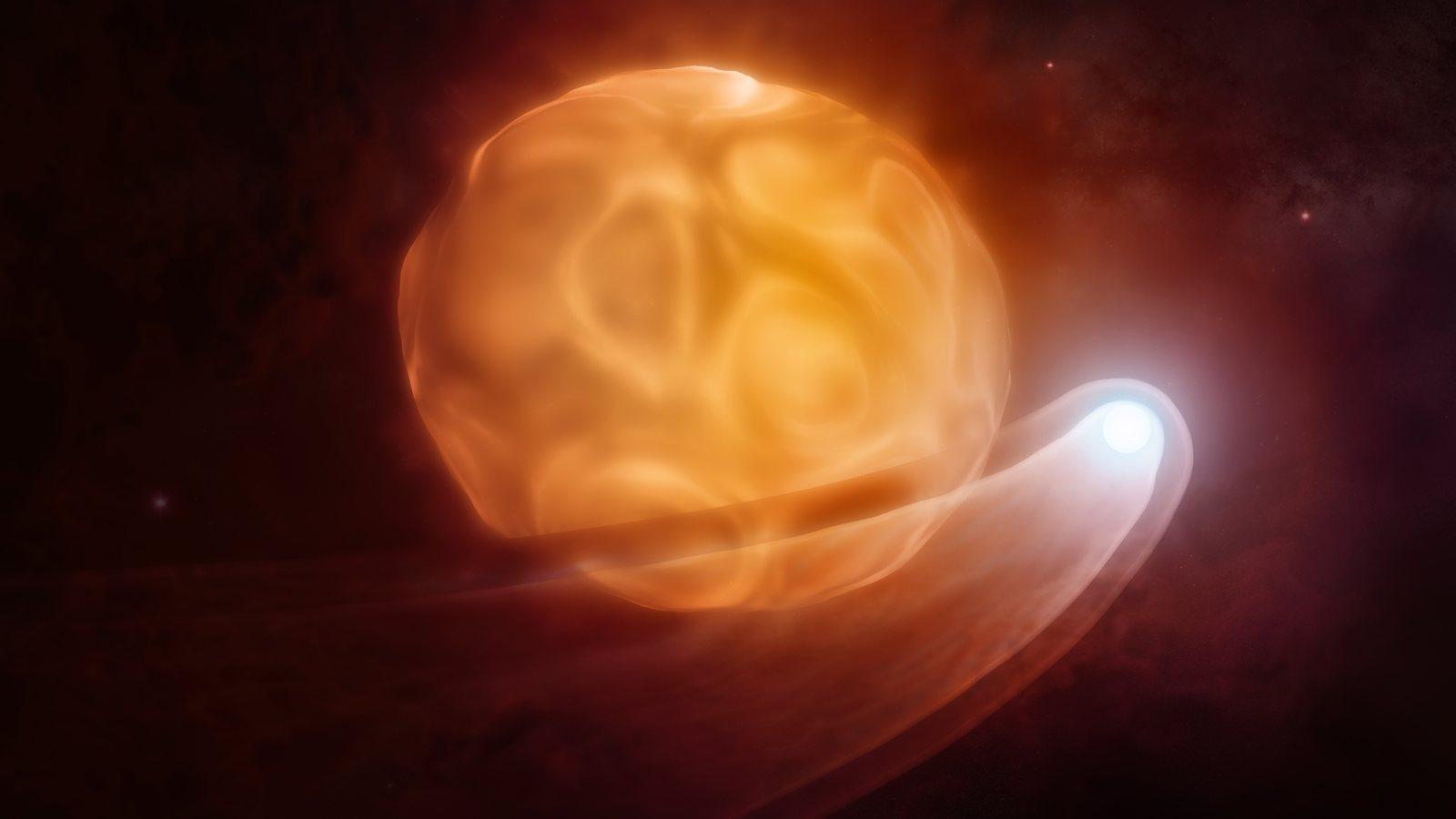
Could an asteroid-mass black hole be hiding inside a star? A team led by Ore Gottlieb at MIT, with the Flatiron Institute, New York University and Stanford, has modeled what happens when a sun-like star swallows one, in a study published on 19 November 2026 in The Astrophysical Journal. The answer splits in two. If the black hole builds a disk of stellar gas before it finishes eating the star, its jets blow the star apart within minutes. If it does not, the star is consumed in silence. The two endings look different from Earth, and that is what makes them interesting for dark matter.
A black hole smaller than a virus
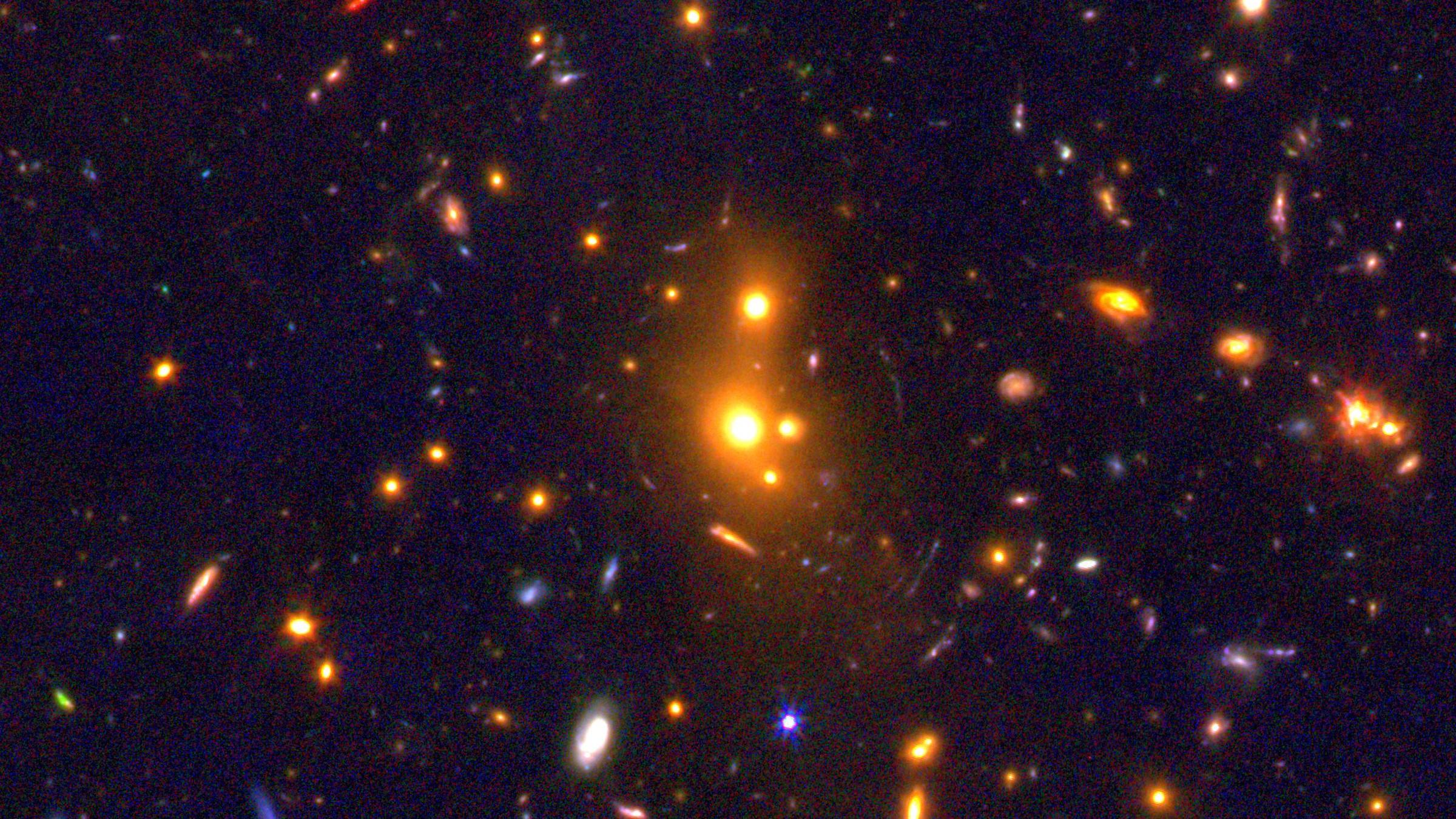
Dark matter makes up roughly 85% of the matter in the universe. It gives off no light and blocks nothing. Astronomers infer it from gravity, through the way galaxies spin and the way light bends around clusters. What it is made of remains unknown.
One long-standing candidate is a population of primordial black holes. They would have formed in the first fraction of a second after the Big Bang, when dense pockets of matter collapsed under their own weight. Nobody has ever seen one. Anything lighter than 10¹⁵ grams has evaporated by now, through Hawking radiation, the quantum emission that slowly drains a black hole. Objects in the asteroid-mass range, between 10¹⁷ and 10²³ grams, could still survive.
Their size is hard to picture. A 10¹⁷-gram black hole has an event horizon, the boundary beyond which nothing can return, on the scale of an atomic nucleus. At 10²³ grams, the horizon is closer to the size of a virus. The equivalent asteroid, meanwhile, would run from a few hundred metres to a few hundred kilometres across.
If dark matter is made of these objects, they are so numerous that they must cross stars all the time. A star that captures one becomes what astronomers call a Hawking star. The name refers to an idea Stephen Hawking raised in 1971, which several teams have revisited since, including with stellar evolution models in 2023. What makes these stars interesting is the environment the black hole ends up in. It sits inside hot, dense, rotating gas, where it cannot stay hidden for long.
It takes a companion to catch a black hole
A star on its own almost never manages it. A black hole crossing the star at high speed loses too little energy to stop, so it leaves and never comes back.
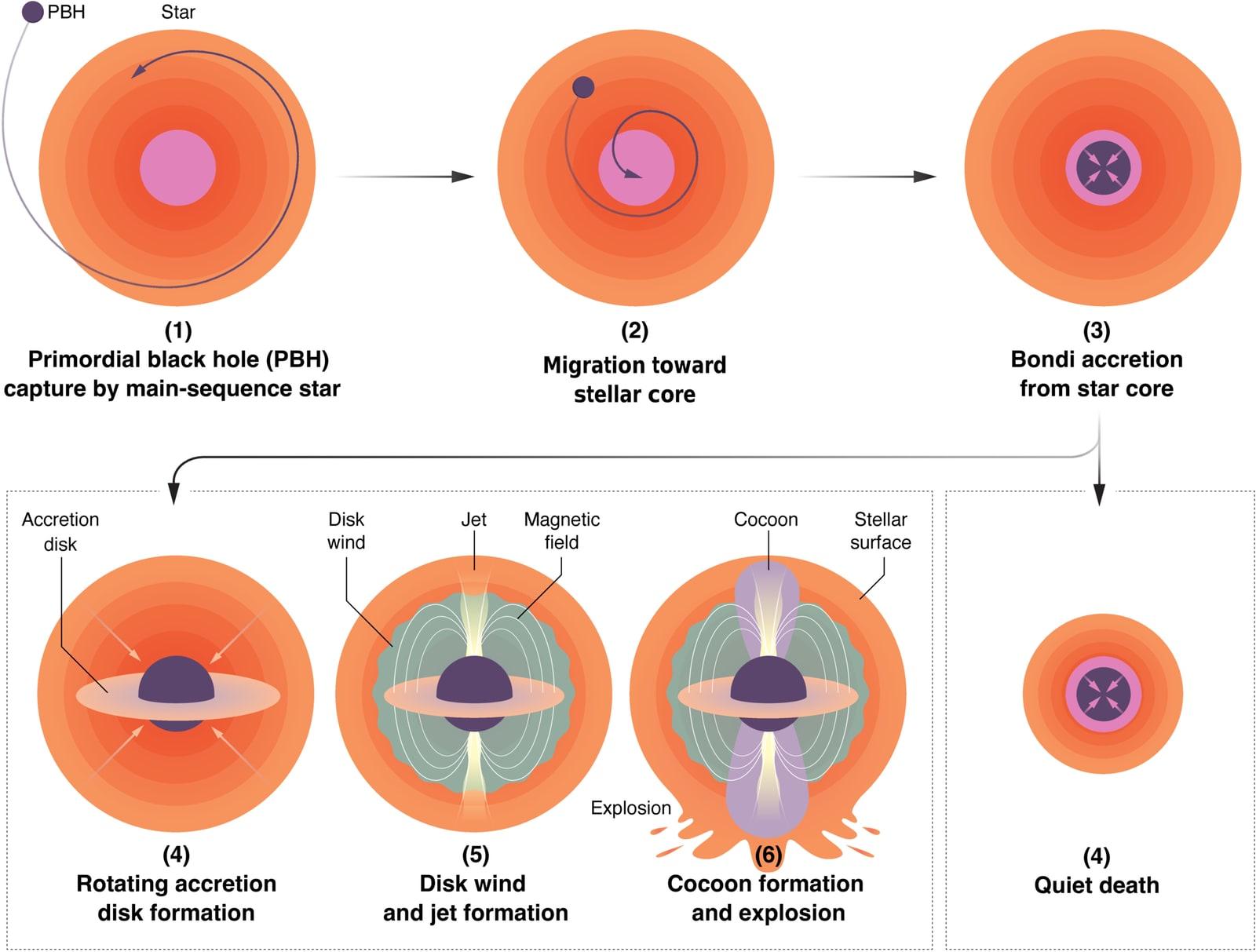
A companion changes the odds. A second star, or a giant planet such as Jupiter, works as a gravitational slingshot. It deflects the black hole onto an orbit that returns to the star. Every passage through the stellar gas costs the black hole speed. The gas it pulls behind it creates a wake, and the drag from that wake is called dynamical friction.
The orbit shrinks a little at every lap. Getting to the centre takes thousands to millions of years. For a Sun-Jupiter system, the capture timescale is about 10 million years. Mass matters too. With a Jupiter analog, the black hole needs at least 10²² grams for the inspiral to finish within the star's lifetime. Lighter black holes need a tighter companion.
Once at the centre, the black hole grows. Gas falls toward it from every direction, a setup known as Bondi accretion, after the astrophysicist Hermann Bondi. The process is inefficient, because most of the energy is carried into the black hole along with the gas. After a few million years, the black hole has still eaten about 1% of the star's mass. That is the turning point.
The disk is a death sentence
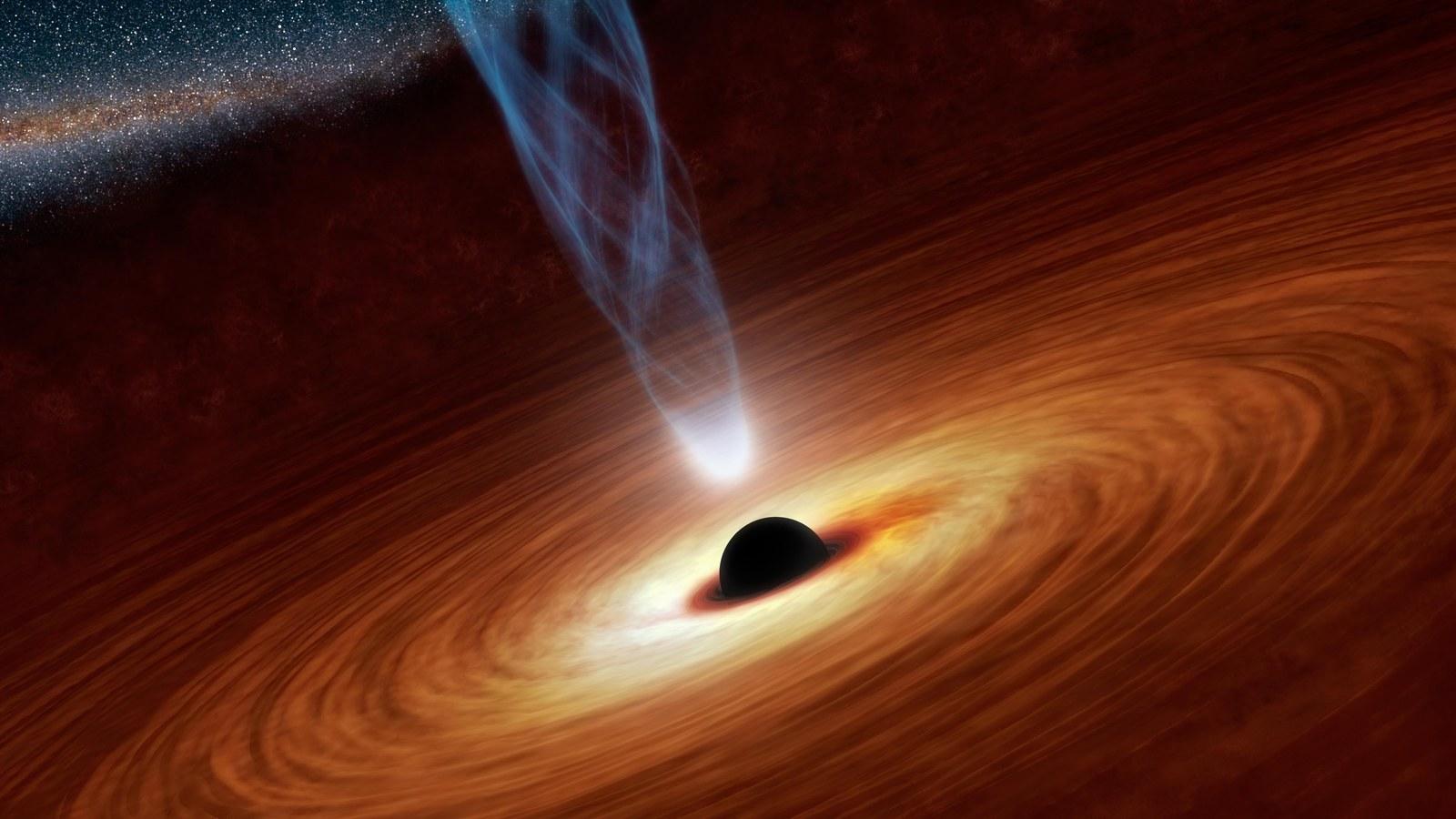
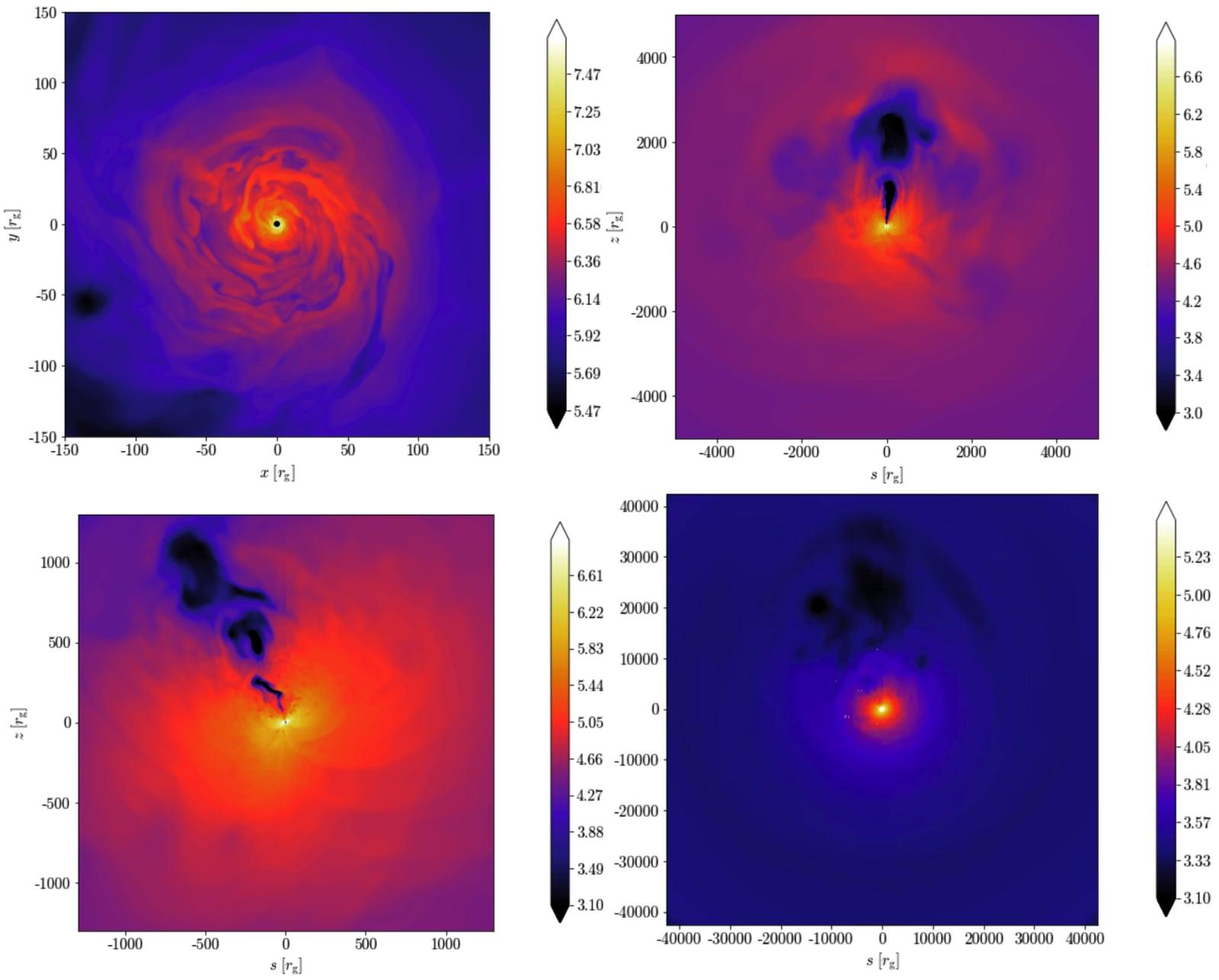
A growing black hole cannot swallow gas just any way. The gas is spinning. If it carries enough angular momentum, meaning enough rotation, it cannot fall straight in. It spirals down and settles into a disk around the black hole. The disk is tiny by stellar standards, and it changes everything.
In models of fast-rotating solar-type stars, the disk appears when the black hole reaches 1% to 100% of the Sun's mass. By then it spins at 80% of the maximum rate general relativity allows. That spin twists space and time around the black hole, and winds up the disk's magnetic field.
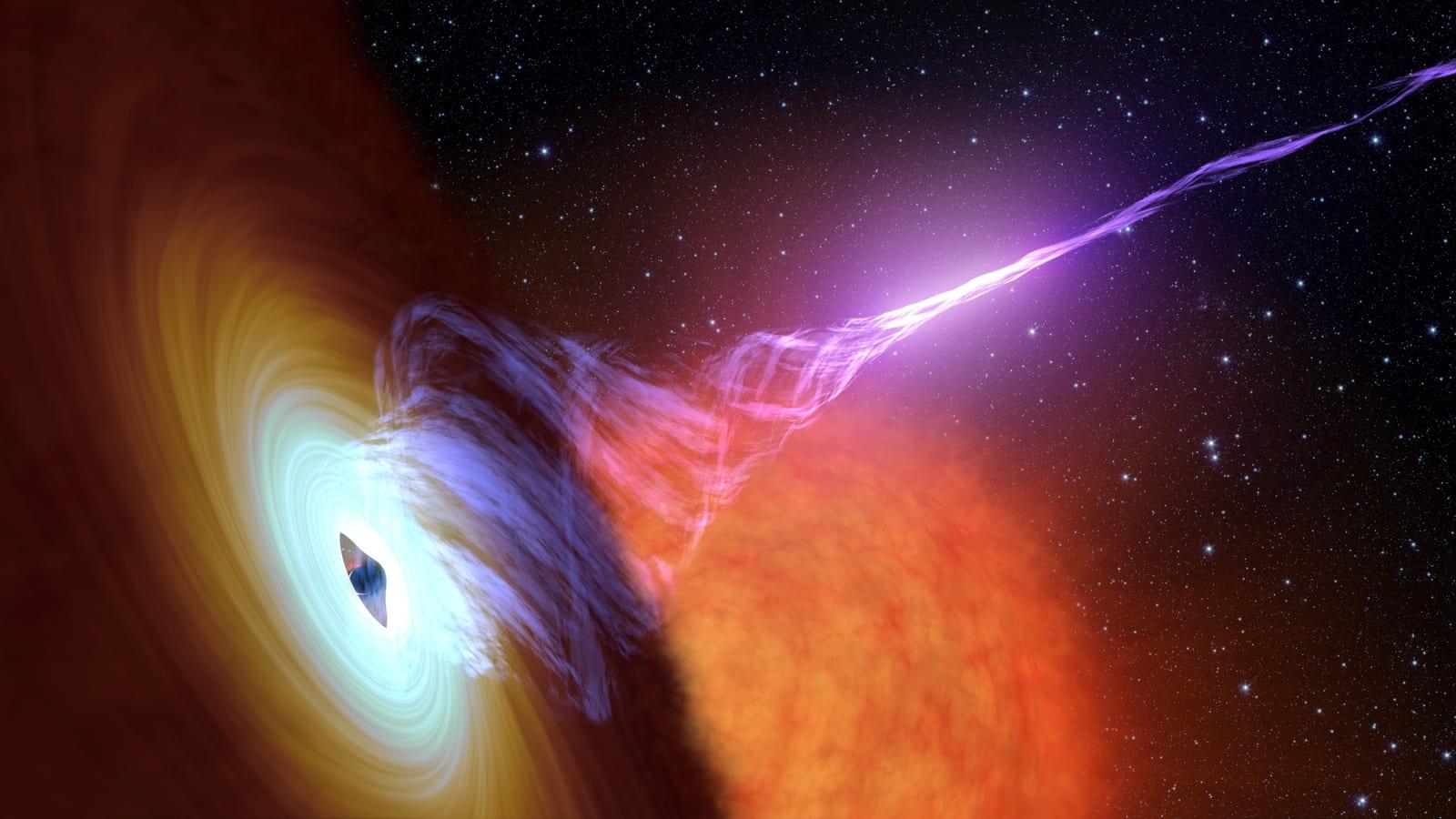
The result is spectacular. Two jets of plasma leave the poles, much like the jets of supermassive black holes. Their power runs from 10⁴⁵ to 10⁵⁰ ergs per second. For comparison, the Sun radiates 3.8 × 10³³ ergs per second, hundreds of billions of times less than the low end of that range. The jets punch through the star, heat the gas and drive a shock. The star is blown apart within tens of seconds to a few minutes.
The authors are blunt about it. Once the disk forms, the star is doomed. Nothing can stop the black hole after that.
The quiet ending
Everything depends on how fast the star is spinning when the black hole reaches the threshold. Young stars spin quickly. Old stars do not. If the rotation is too slow, or if the black hole arrives too late, the gas never carries enough angular momentum to make a disk. The black hole keeps growing by swallowing matter in a roughly spherical flow.
The star is then consumed over a few million years, with no flash. What remains is a black hole with the mass of the material it swallowed, a few tenths of the Sun's mass, and little or no light. This ending does not look like an explosion. It looks like a disappearance.
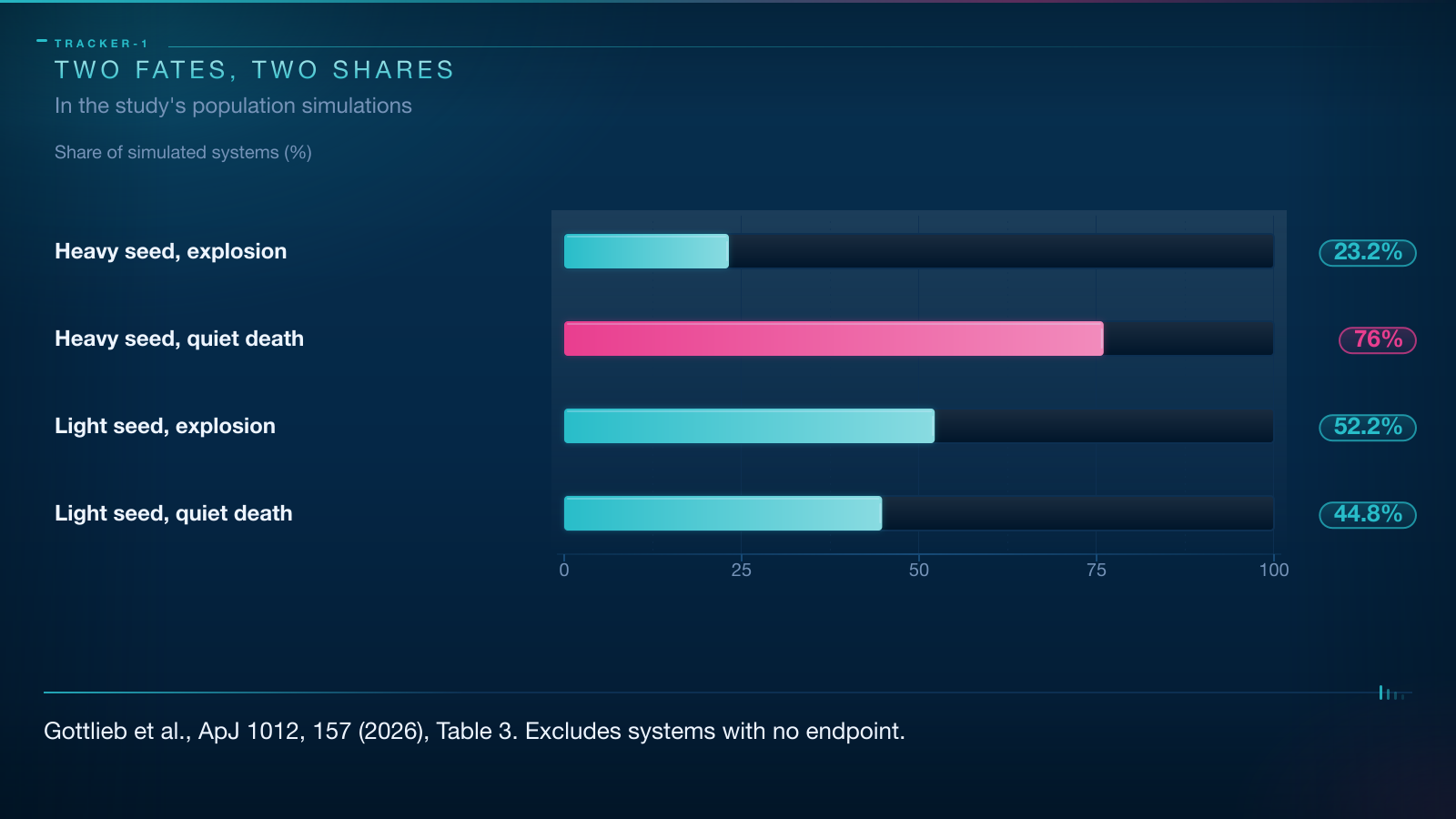
Population simulations put numbers on the split. The team drew thousands of systems at random, with different masses, spins and companions, and followed each one. For a heavy seed of 10⁻¹¹ solar masses, 23.2% of systems end in an explosion and 76% in a quiet death. For a light seed of 10⁻¹⁶ solar masses, the shares become 52.2% and 44.8%.
Those percentages describe stars that have already captured a black hole. Capture itself is rare, and the absolute rate depends on how many primordial black holes are around. The remaining systems, 0.8% in one case and 3% in the other, had not reached an endpoint within the simulated window.
What a telescope would see
Would any of this be visible? Yes, the authors argue, but the two branches look different.
In the explosive branch, the first signal is a flash of soft gamma rays and X-rays, lasting a few minutes. It is only visible if the jet points at Earth, because a jet concentrates its emission into a narrow cone. Next comes an ultraviolet and blue signal that lasts about a day. It is emitted in every direction, which makes it the most promising target for a blind search. A radio afterglow follows over a few days.
The numbers give a sense of the challenge. The radio afterglow reaches about 200 microjanskys at 1 gigaparsec, or 3.26 billion light-years. A jansky is a unit of radio flux, and a microjansky is one millionth of a jansky. The authors also describe the sequence observers would see, X-rays and gamma rays first, then optical and infrared light, then radio.
Some of the instruments already exist. Wide-field monitors such as Swift and Fermi watch for gamma-ray and X-ray flashes. China's Einstein Probe adds a soft X-ray view. For ultraviolet light, the ULTRASAT satellite is designed to survey a large fraction of the sky. From the ground, the Zwicky Transient Facility and the Vera C. Rubin Observatory could catch the fast blue transients.
The real risk is confusion. An ordinary supernova shines for weeks, and its light is powered by the decay of nickel-56. Here there is no nickel-56, the flash is fast, and the star is too light to explode as a supernova in the first place. Ore Gottlieb compares the process to a parasite eating the star from inside. Some low-luminosity gamma-ray bursts and engine-driven supernovae can produce similar signals, so astronomers will need several clues, not one flash.
The expected rate is uncertain. If primordial black holes made up most of the dark matter, and with optimistic capture assumptions, the authors estimate that the event rate could reach that of low-luminosity gamma-ray bursts. In the pessimistic case, events would be far rarer and would show up first in the most sensitive channels.
Dark matter in the background
A detection would not prove that dark matter is made of primordial black holes. It would provide a measurement. The number of events per volume and per time reflects the density of these black holes, and therefore the fraction of dark matter they account for. A non-detection would give the opposite, an upper limit. Either way, astronomers would be testing the idea.
Gravitational waves offer a second channel. The explosive branch leaves behind a black hole of 1% to 100% of the Sun's mass, with a spin of 0.8. If it ends up in a tight pair with another compact object, the merger would emit gravitational waves. Black holes below the mass of a star do not form through standard stellar evolution. A detected merger would therefore be a strong signature. It would also be rare, and the authors treat it as a secondary channel.
The authors are careful about their own work. It is a first global framework, not a definitive treatment. Each stage deserves dedicated study, capture is rare, rates vary by orders of magnitude, and the mass of the seeds is unknown. In other words, the study does not show that Hawking stars exist. It shows what they would look like, and how to find them.
Going further
- The telescopes that could catch one of these flashes: Swift, which hunts gamma-ray bursts, and Fermi, which surveys the sky in gamma rays.
- The key ideas: black holes, dark matter and X-rays.
- The sky is also open from home: try our interactive sky map, our observing guide and the astrophotography gallery.
- The study: Gottlieb, Cantiello, Norton, Van Tilburg and Kleban, The Astrophysical Journal, 2026, open access.