On November 12, 2026, NASA released a collage of nine strong gravitational lenses observed by Hubble. These massive galaxies bend light from objects farther away, turning their images into arcs, rings or several bright points. DESI, the Dark Energy Spectroscopic Instrument at Kitt Peak, found them first. Hubble then gave them a sharp look. The set is meant to prepare Roman, launched on August 30, 2026, for its hunt for dark matter.
Nine lenses, nine ways to bend light
The collage has nine panels, labelled A to I. Each one shows a foreground galaxy acting as a lens. Behind it, a more distant galaxy has its light bent, stretched and sometimes copied. The lens is not made of glass. Its mass, stars and dark matter together curve the space around it.
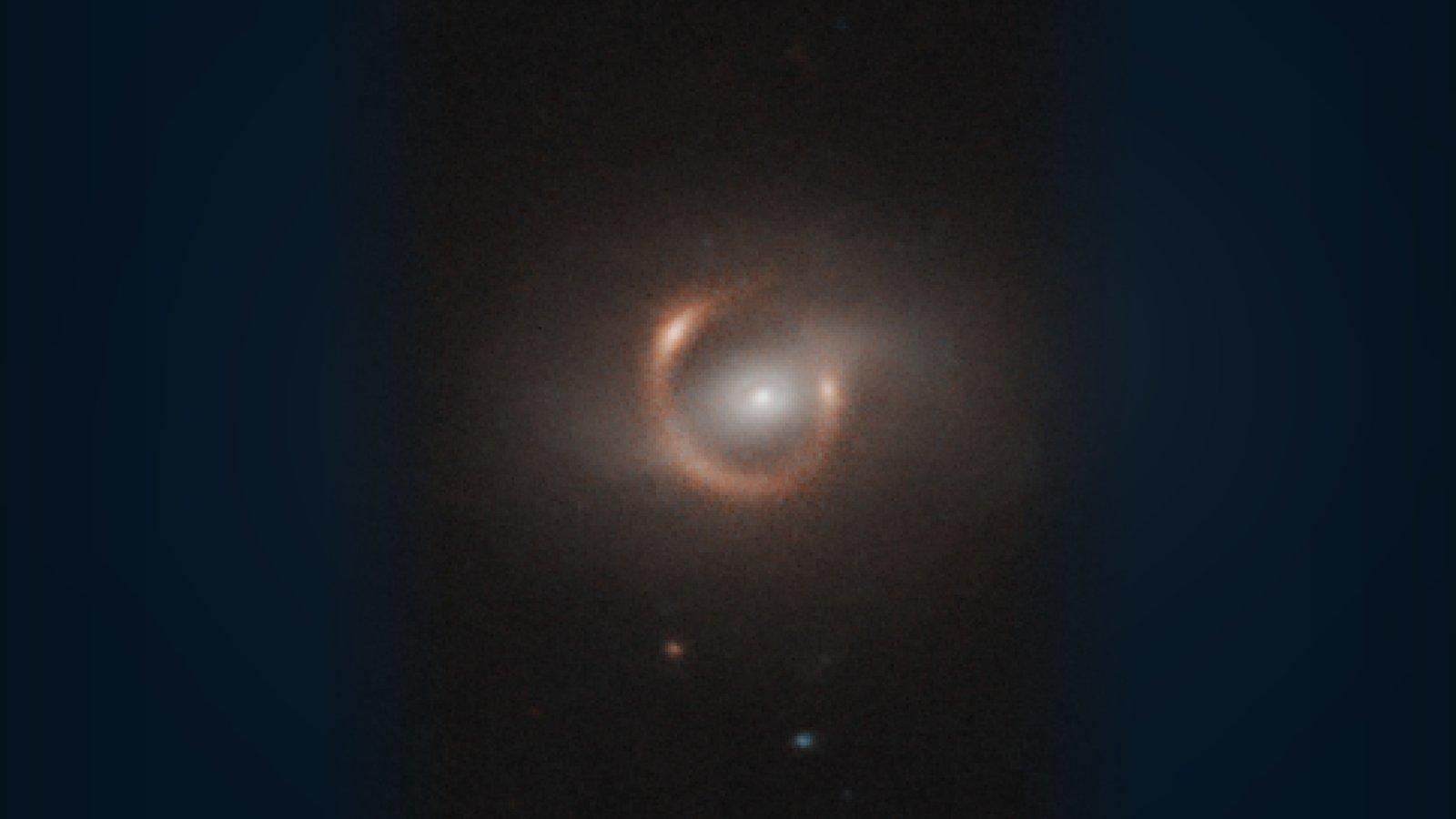
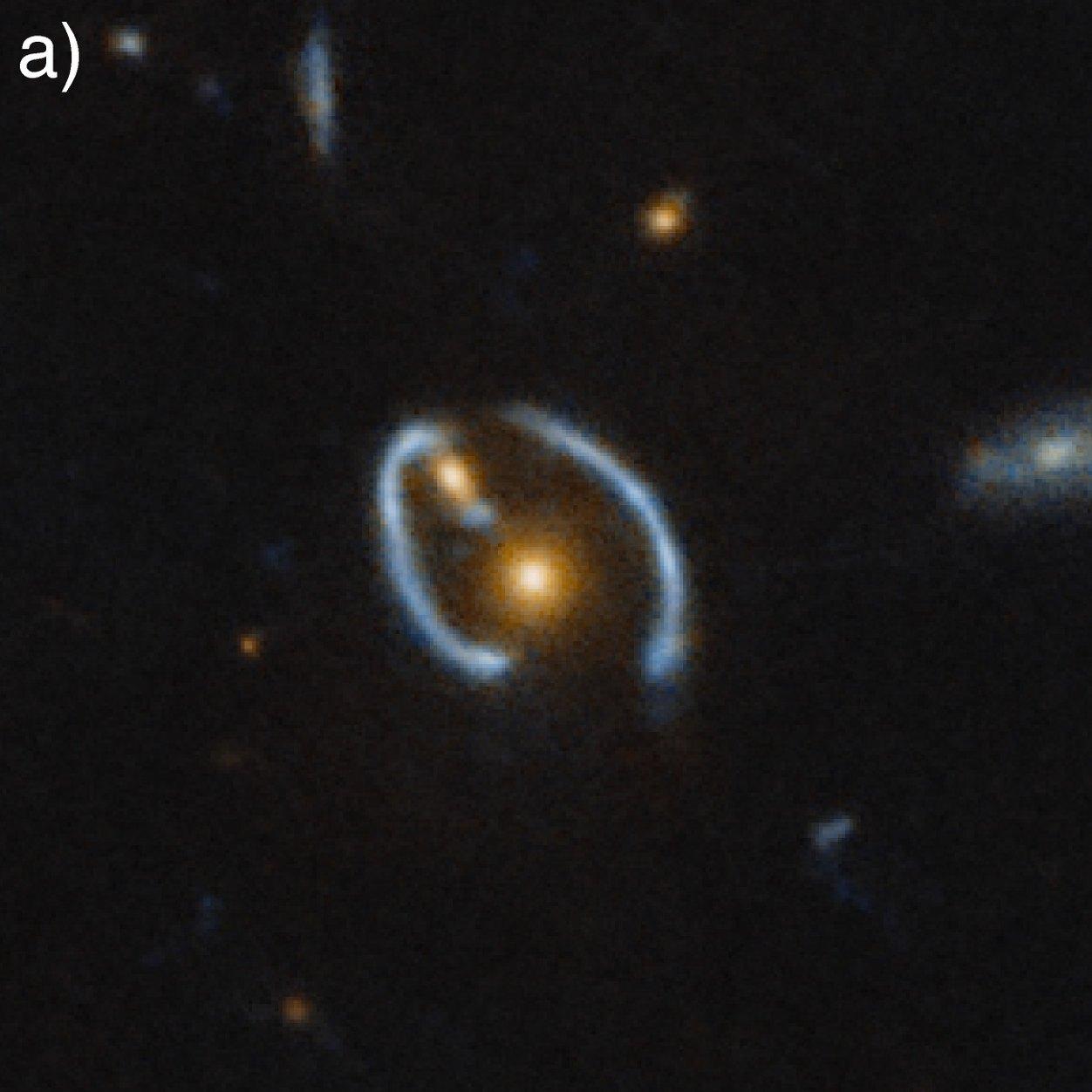
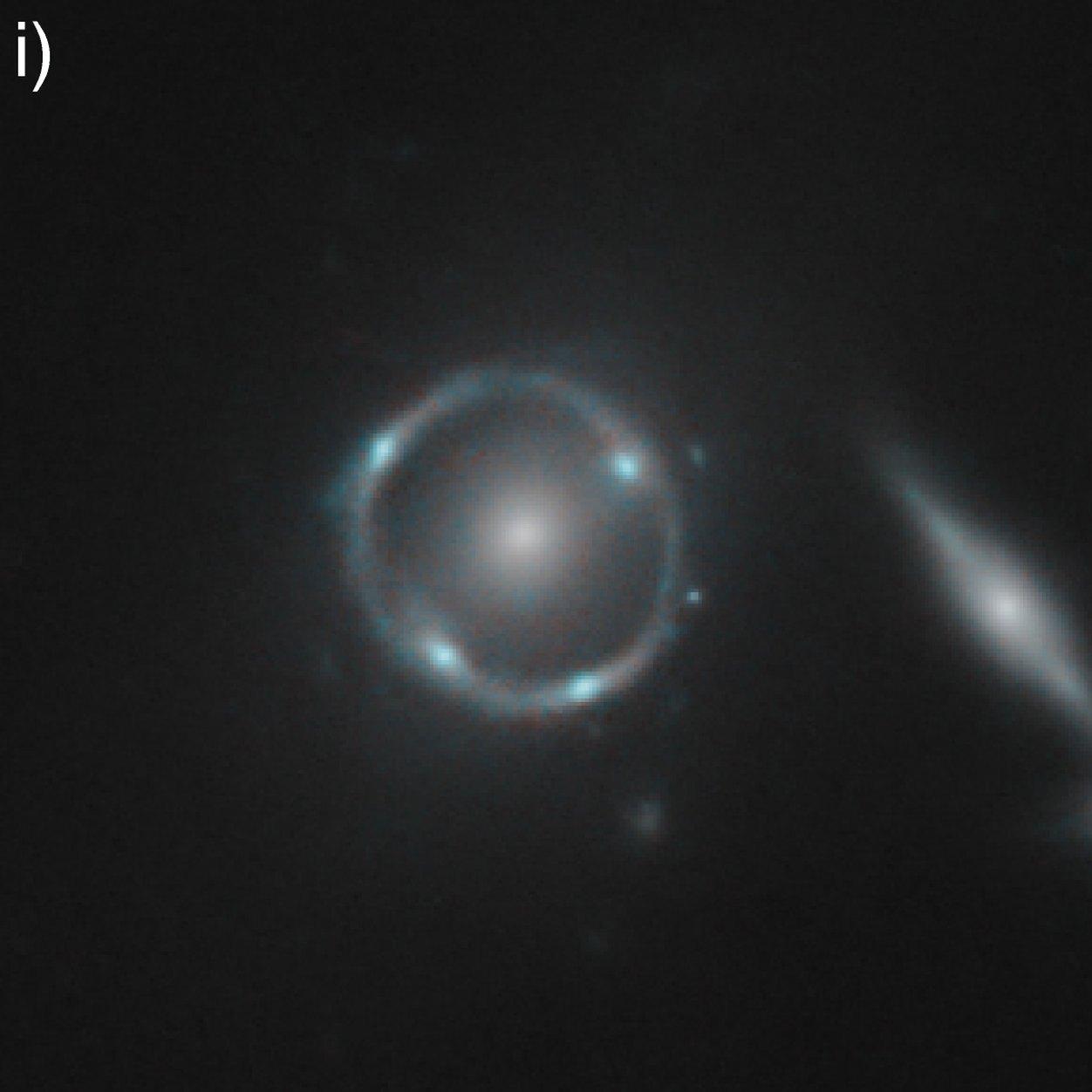
Panel A shows an arc and a counter-arc. The background galaxy appears twice, on either side of two foreground galaxies whose masses add up. Panel F holds an Einstein ring, a rare setup in the set. The lens and the source line up so well that the background image almost completely surrounds the foreground galaxy. Panel I shows a quadruply lensed galaxy, copied into four blurred points around the centre. Panel C shows another quadruple system, with two bright knots that are probably star-forming regions.
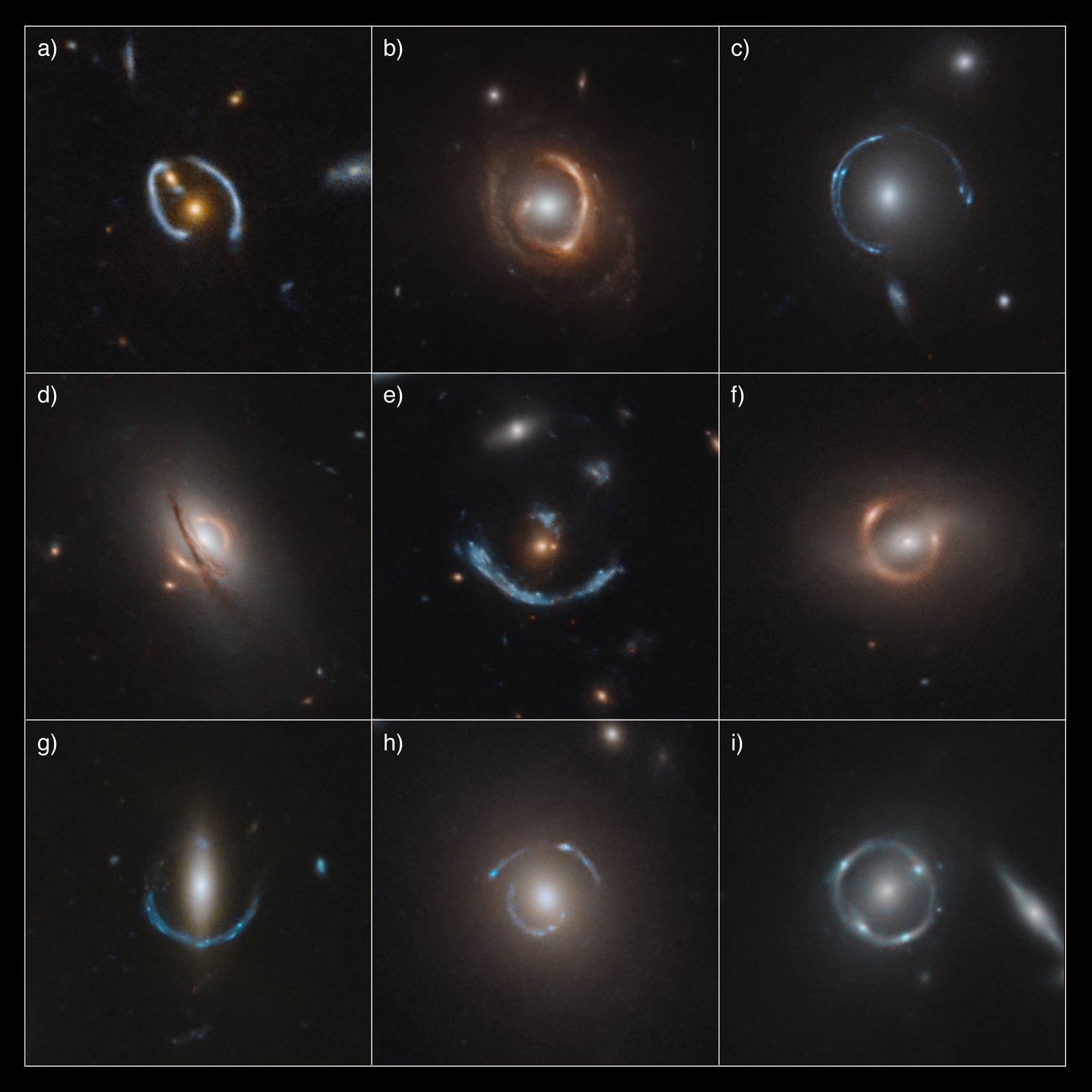
The variety goes beyond the shape of the arcs. Some arcs look blue, others red. Blue points to young stars, red to older ones. Colour therefore tells us about the stellar population of the background galaxy, not just its position. Most lens galaxies are ellipticals, older, denser and more compact than average. Panel G shows an elongated lens, possibly a trick of perspective, and panels B and F show spiral arms.
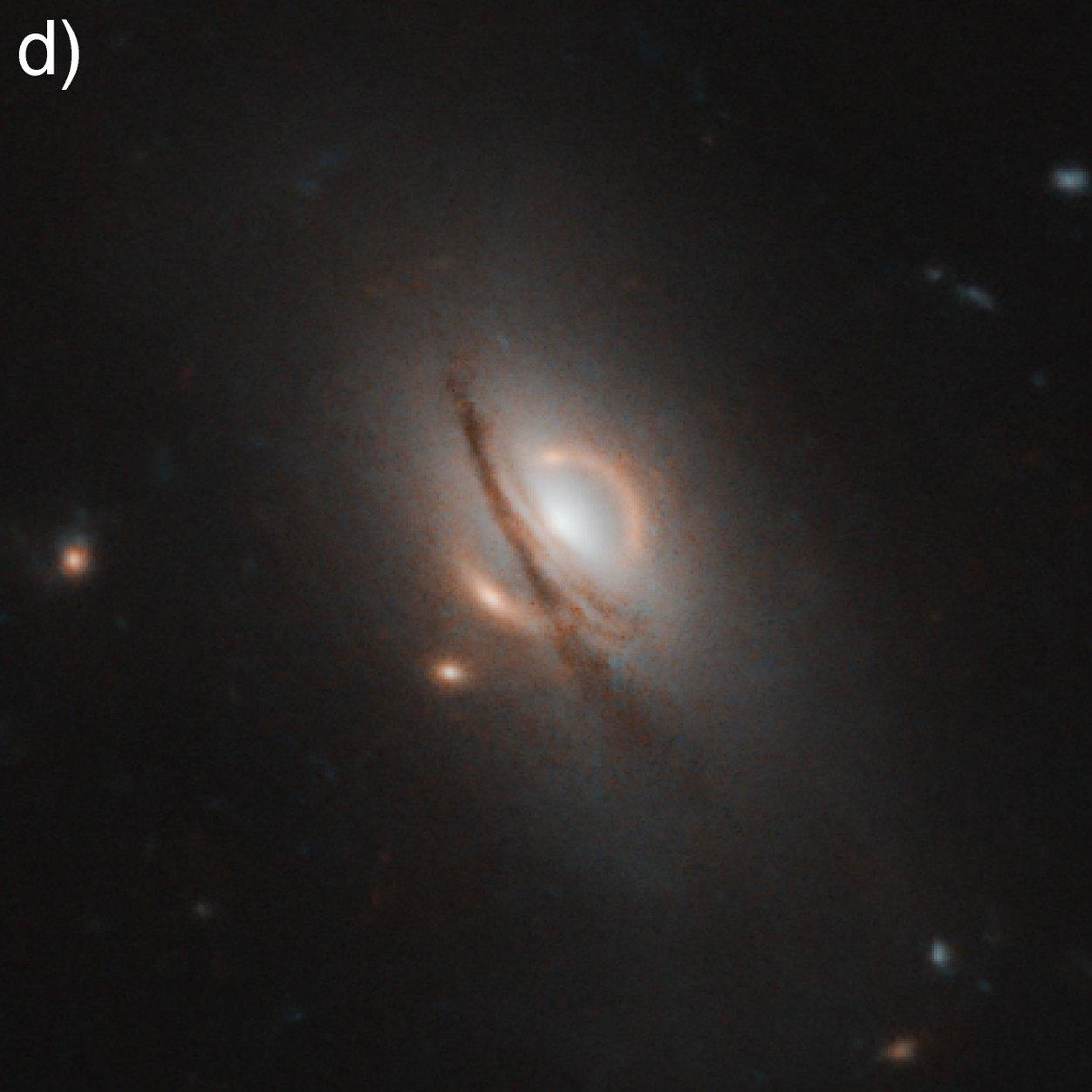
Panel D adds a detail that Hubble is well suited to catch. Its lens galaxy is crossed by a dark dust lane, a rare feature for a lens. The lane cuts through the bright arc and may hide part of an Einstein ring. Infrared light passes through dust more easily, so Roman may show whether the ring closes.
How a lens weighs dark matter
A gravitational lens is not just a pretty picture. It is a measurement. The shape of the arcs depends on the total mass of the foreground galaxy. Astronomers build a model of the lens, compare the position and curvature of the images, then adjust the mass until the model matches the data. Stars, gas and dark matter all count.
The method is indirect, but it works. It is one of the few ways to weigh the dark matter of a single galaxy. Hubble supplies what ground surveys struggle to provide: a sharp view of the arcs in visible and ultraviolet light. Models can then look for tiny flaws in the curvature. Such flaws would betray invisible mass concentrations along the light path.
Cold dark matter theory predicts exactly that kind of lumpiness. In this picture, dark matter does not sit in one smooth blob. It clumps into small structures, with masses from one million to one billion solar masses. For scale, the dark matter halo of our Milky Way weighs about 1.3 trillion solar masses, or 1,300 billion. The clumps are dwarfs next to our halo, and their effect on an arc is tiny.
That is where the nine images earn their keep. They offer a range of shapes, masses and colours. Researchers can test their models on very different cases before applying them to the larger set of lenses Roman should find. NASA describes a software tool, a "super-intelligence tool", to search for similar arcs in the coming images. The name sounds grand. The job is practical: spot and measure fast, at a scale no human eye can follow.
Roman, the lens harvester
Roman launched on August 30, 2026, at 7:26 a.m. EDT on a SpaceX Falcon Heavy from Launch Complex 39A in Florida. It began a three-month trip to its final orbit. Its main advantage is simple: a wide field. Roman's view is at least 100 times larger than Hubble's, with comparable sharpness.
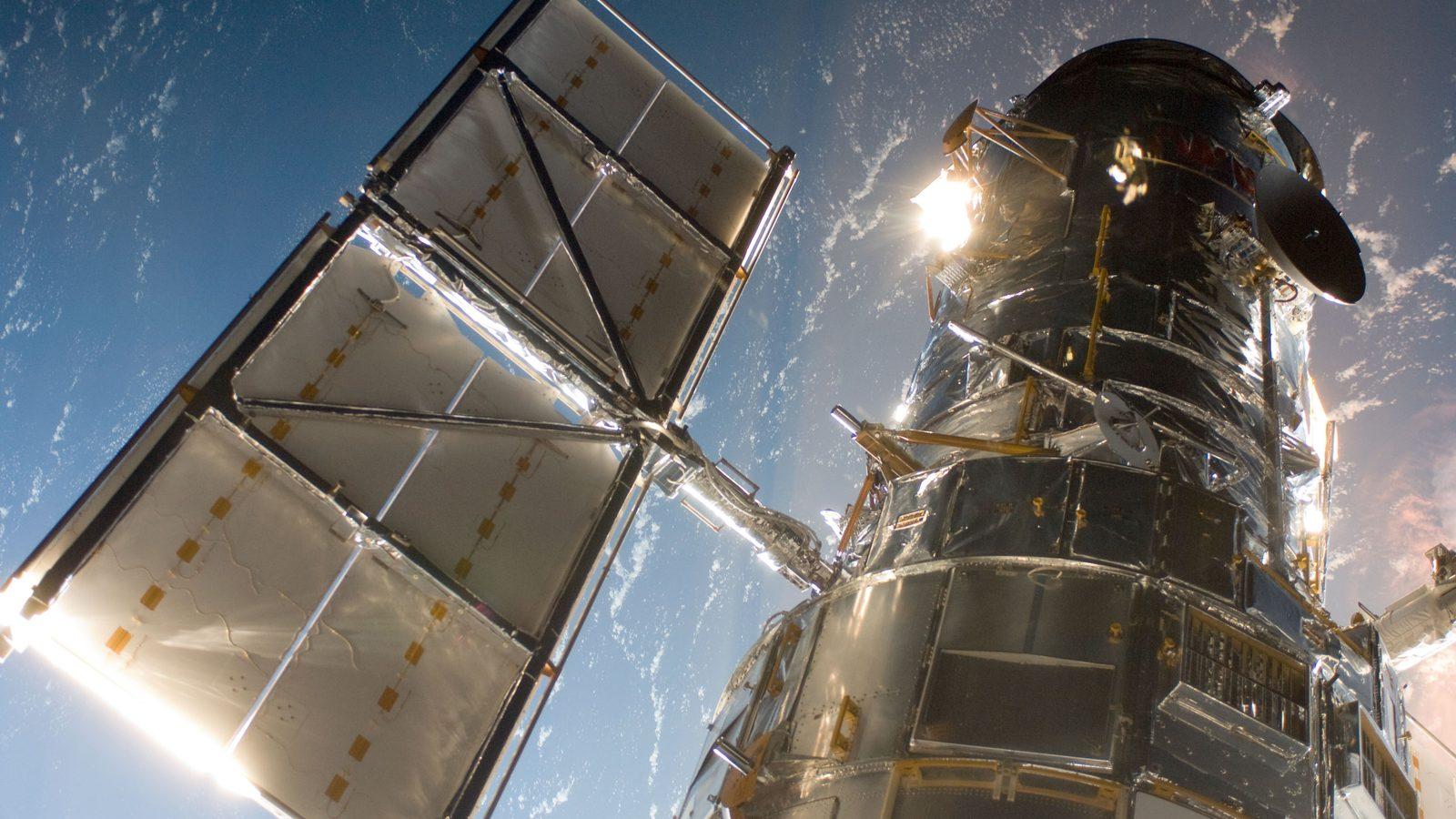
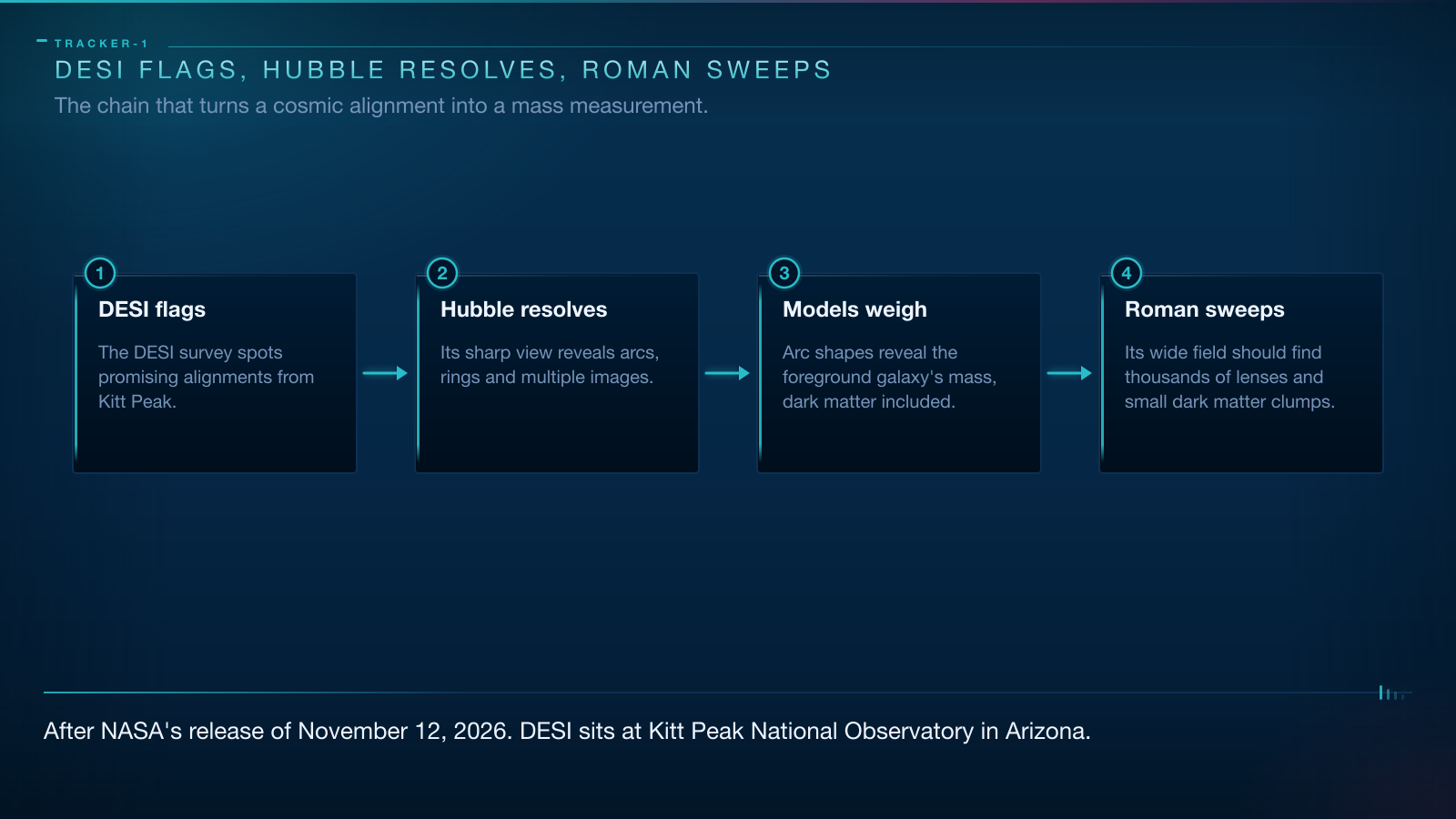
The division of labour is easy to state. Hubble isolates one lens and shows its details. Roman images large patches of sky and collects many lenses at once. One works like a magnifying glass, the other like a net. NASA pairs them for that reason. If Roman finds an especially interesting lens, Hubble can return to it in visible and ultraviolet light.
Roman observes mainly in the infrared, with some visible light. Infrared passes through dust that blocks some arcs. It also reaches farther, to more distant and older galaxies. The telescope should thus weigh many lens galaxies at a range of distances and trace how dark matter has organised itself.
A test bed, not an answer yet
One temptation is worth resisting. The nine images are not a dark matter detection. NASA writes that the observations could confirm or challenge a theory, not that they already have. The clumps between one million and one billion solar masses remain a prediction. Seeing them will take finer models, more arcs and deeper images.
The programme is preparation in the strong sense. Hubble provides the textbook cases and the measurement tools. Roman should provide the volume. Researchers describe a large and varied sample, able to test the theory on a much broader set. The question is no longer whether a lens can bend light. It is whether tiny flaws in the arcs carry the signature of the predicted clumps.
The nine panels also teach diversity. A lens galaxy is not always a neat elliptical. It can have spiral arms, a dust lane or an elongated shape. Every detail changes the model, and therefore the mass. By stacking cases, astronomers learn to separate physics from geometry. That sorting is what will make Roman's measurements usable.
Going further
- Mission pages: Hubble and Roman, for their instruments, orbits and observing programmes.
- Key concepts: dark matter, galaxies and infrared light.
- For stargazers: the sky map helps locate the constellations around these lens galaxies.
- Sources: NASA's November 12, 2026 release, the Roman launch release of August 30, 2026 and the Roman mission page.