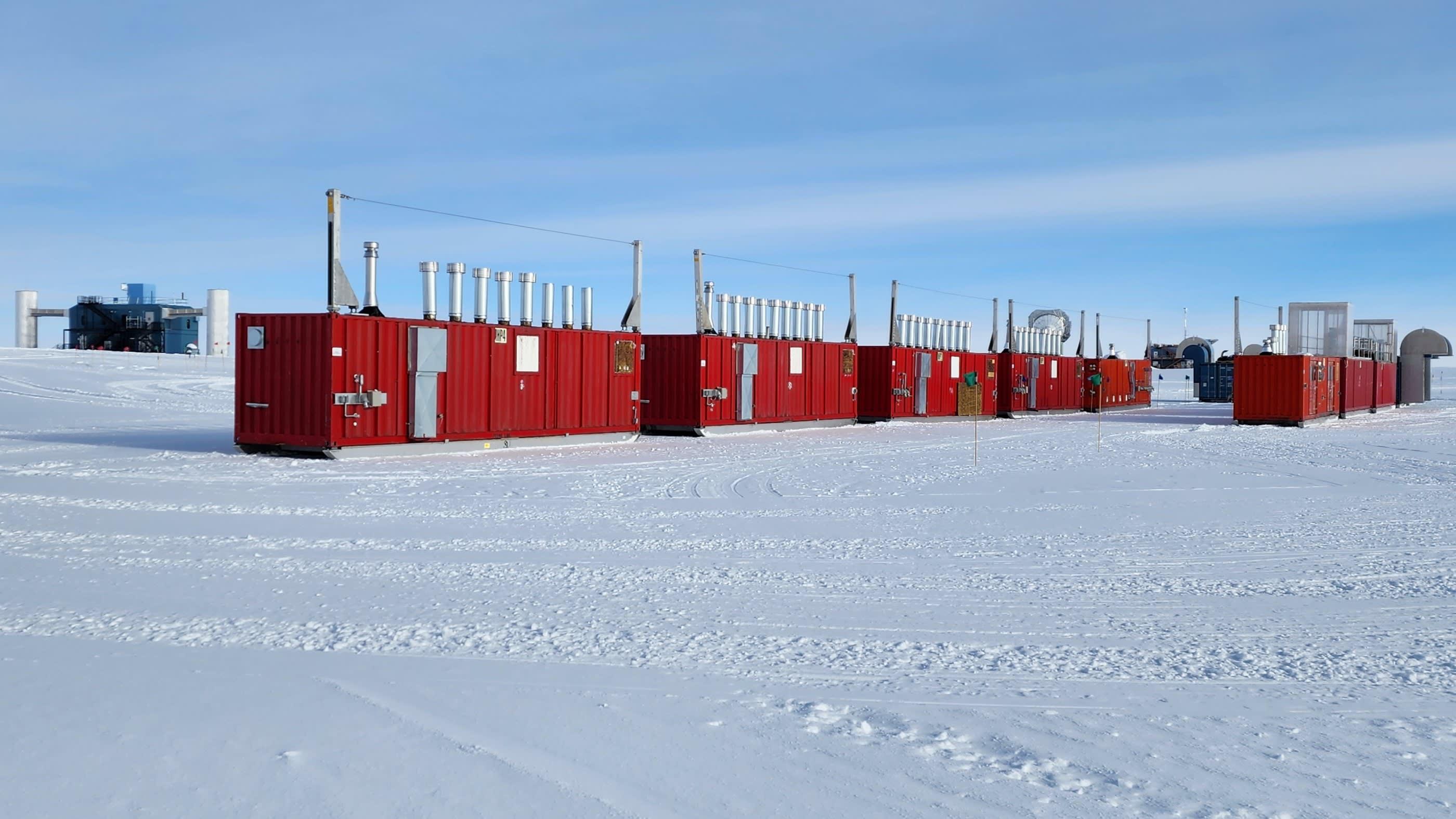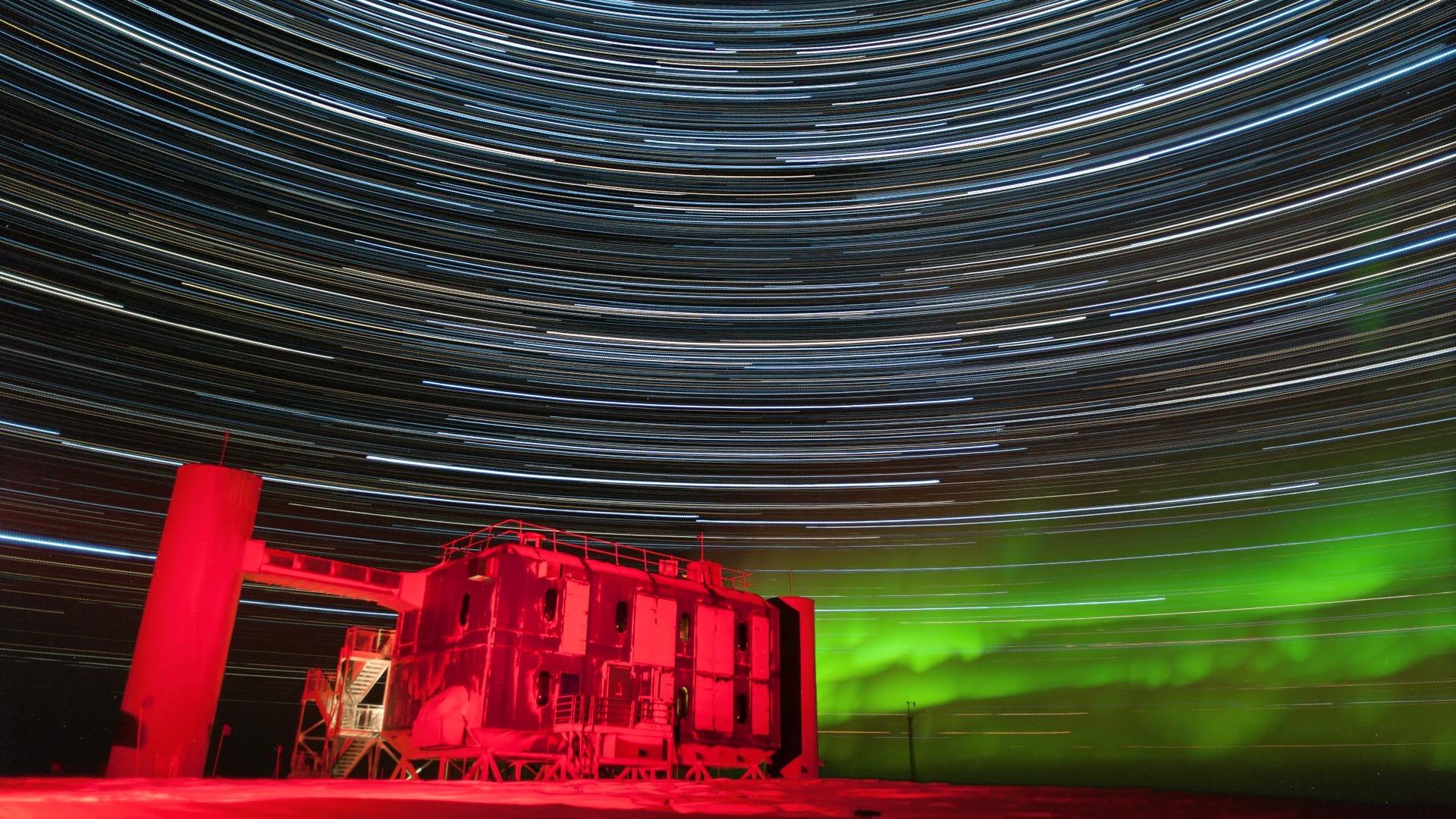
On 6 October 2026, the Royal Swedish Academy of Sciences crowned an 82-year-old Belgian physicist for turning a cubic kilometre of Antarctic ice into the largest particle detector in the world. Francis Halzen wins the Nobel Prize in Physics for his decisive contributions to the IceCube Neutrino Observatory and for the discovery of high-energy neutrinos from the cosmos. Behind the award lie an idea that was called crazy in the 1980s, a twenty-year building site in the snow, and another way of looking at the universe, with particles instead of light.
A Belgian, a cubic kilometre of ice and some ghost particles
You do not need to know what a neutrino is to grasp the scale of this prize. The Royal Swedish Academy of Sciences sums it up in a single line: this year honours "ghost messengers from space". The star of the day wears no spacesuit and has never launched a rocket. He spent his career convincing a scientific community that the secrets of the universe's most violent objects could be read inside a block of ancient ice.
The laureate stands alone. The prize is not shared, and the 12 million Swedish kronor, a little over a million dollars, go to one man. The award recognises a collective project, run by roughly 450 scientists and engineers from 58 institutions in 14 countries, but it singles out the person who had the idea first and carried it to the end.
The official release quotes the committee: "Francis Halzen has led an international team of researchers and engineers who have provided us with a fantastic instrument. His tenacity and scientific vision has paved the way for a new kind of astronomy." A fantastic instrument here means a cube of ice one kilometre on a side, pierced by 86 boreholes and home to more than 5,000 light sensors. A telescope that does not look at the sky, but waits for something to pass through it.
The theorist the ice caught
Francis Halzen was never meant to spend his life in the cold. Born in Belgium in 1944, he trained in particle physics, the study of the basic building blocks of matter, and earned his doctorate at Leuven in 1969. Three years later he joined the physics faculty at the University of Wisconsin-Madison, where he still teaches. A theorist by training, he describes his shift as an accident.
It starts with a talk at the University of Kansas in the autumn of 1987. In the audience, a glaciologist, E. Zeller, tells him about a Soviet plan: use radio antennas planted in Antarctica to catch the pulses produced by neutrinos in the ice. Halzen goes home, does the maths with two colleagues, Todor Stanev and Enrique Zas, and concludes the method would only work at unreachable energies. But the idea sticks. What if, instead of radio waves, they looked for a different signal, one made of light?
He writes to his friend John G. Learned, then spokesperson for an underwater detector project off Hawaii called DUMAND. In June 1988 the two publish the first paper describing a neutrino observatory built in polar ice. The principle is simple and dizzying: the ice serves as both the target and the detection medium.
Halzen later recalled, in an essay that became a classic, "Antarctic Dreams", what kept him going: "I suspect that others must have contemplated the same idea and given up on it. Had I not been completely ignorant of what was then known about the optical properties of natural ice, I would probably have done the same." This time, ignorance served science.

The road was long. In 1991 the team lowers photomultiplier tubes into existing boreholes on the Greenland ice sheet and confirms that the ice lets light travel far enough. Then comes AMANDA, a first detector at the South Pole, built in stages between 1993 and 2000. Early results disappoint, because air bubbles trapped in the first hundred metres of ice scatter the light and blur the particles' paths. Deeper down, the ice turns out to be pure and transparent over hundreds of metres. It is Halzen who pushes to move the instruments lower, to 1,500 metres and beyond.
AMANDA proves the method works, but it is too small to snare the most energetic neutrinos. In 1999, as principal investigator, Halzen submits a proposal for a cubic-kilometre detector. The U.S. National Science Foundation approves funding in March 2002. Construction begins in 2004 and ends in 2011. Twenty-four years after that small talk in Kansas, the idea has become an instrument.
Neutrinos, the messengers that cross everything
Start with the particle. A neutrino is an elementary building block of matter, like the electron, but with no electric charge and almost no mass. That lack of charge leaves it indifferent to everything around it: magnetic fields do not bend it, dust does not stop it, a wall of lead barely slows it. Physicist Wolfgang Pauli proposed its existence in 1930 to explain an oddity of radioactivity, and it took until 1956 to detect one for real, next to a nuclear reactor.
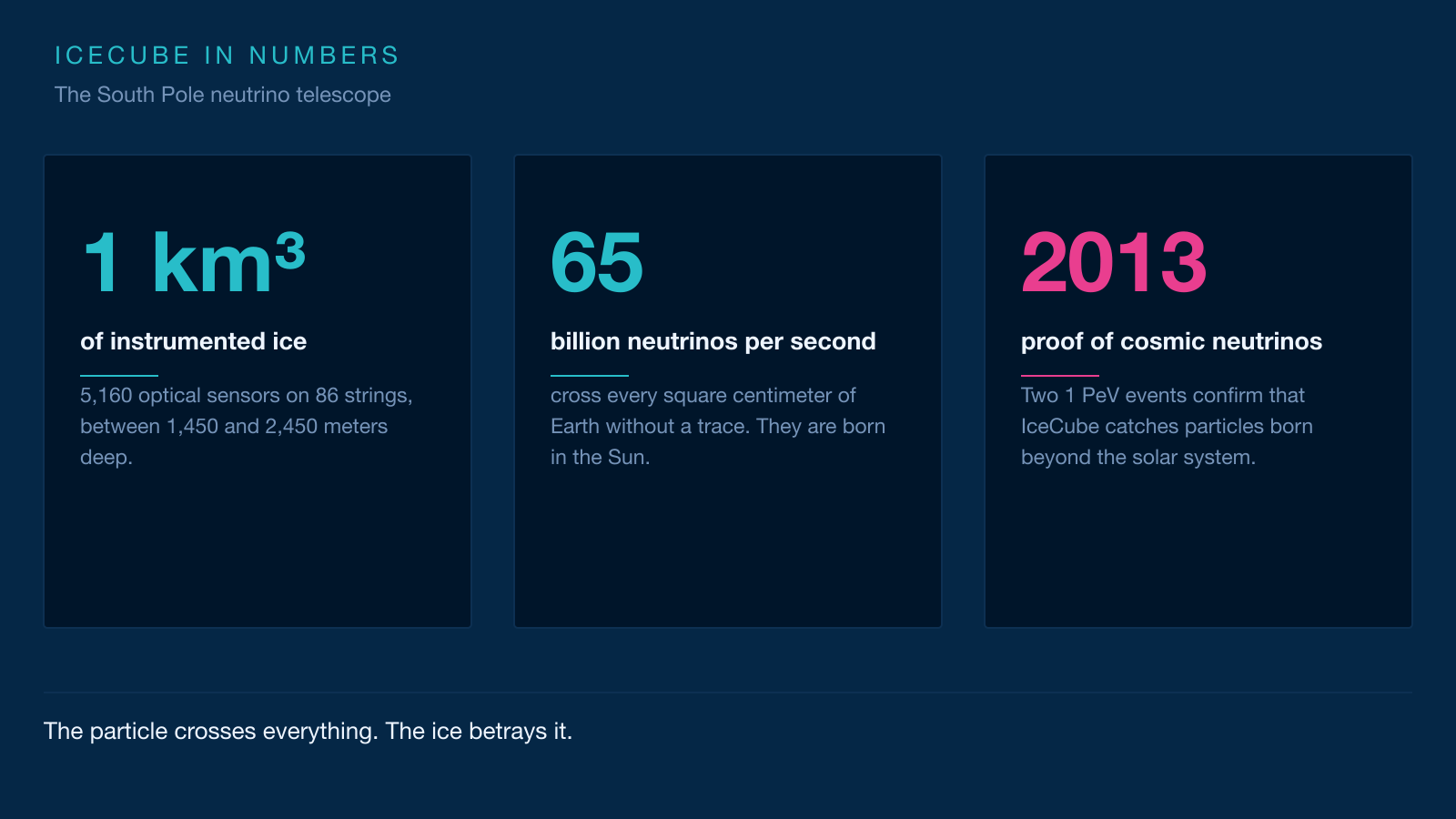
This discretion makes it the worst and the best of messengers. The Sun produces them in unimaginable numbers: about 65 billion cross every square centimetre of Earth each second, and the vast majority pass without leaving the slightest trace. But because a neutrino never strays from its path and loses no energy on the way, one that arrives here carries raw information about where it came from.
That is exactly what cosmic rays cannot do. These particles, protons and atomic nuclei flung out at energies no human machine can reach, rain constantly on the atmosphere. Since their discovery in 1912 by Victor Hess, their origin has been one of the great mysteries of astrophysics. The problem is that, being electrically charged, they are twisted by the magnetic fields of space and arrive on Earth with no trace of their starting point. There is no way to retrace the route.
Neutrinos, by contrast, fly straight. And it turns out that the processes that accelerate cosmic rays also make neutrinos. When a fast proton strikes matter or light near its source, the collision produces unstable particles called pions, which decay into both gamma rays and neutrinos. The gamma rays can be absorbed along the way by dust and light. The neutrinos keep going. They are the crumbs left behind by cosmic rays, and IceCube picks them up.
How to catch a particle that never stops
If a neutrino crosses everything, how do you trap it? By waiting for it to take a wrong turn. A neutrino can cross light-years of lead without flinching, but very rarely it slams into an atom. The odds depend on its energy and on how much matter it passes through. For a very high-energy neutrino, the cross-section, meaning the apparent size of the target it sees, is about 10⁻³³ square centimetre, a number beyond imagination. To make the lottery come up often enough, you need an enormous volume of matter, on the scale of a cubic kilometre.
When the collision finally happens, it produces charged particles. And those leave a light signature we know how to read. Racing through the ice faster than light travels inside it, they emit a bluish wave called Cherenkov radiation.
The effect is the luminous cousin of a sonic boom. A plane flying faster than sound creates a cone of shock waves, hence the bang. A charged particle moving faster than local light does exactly the same thing, but with photons. In ice, light travels at about 76% of its speed in a vacuum, roughly a quarter slower. The charged particle born from the neutrino, by contrast, keeps almost all its speed. So it outruns the light around it and leaves a blue cone behind.
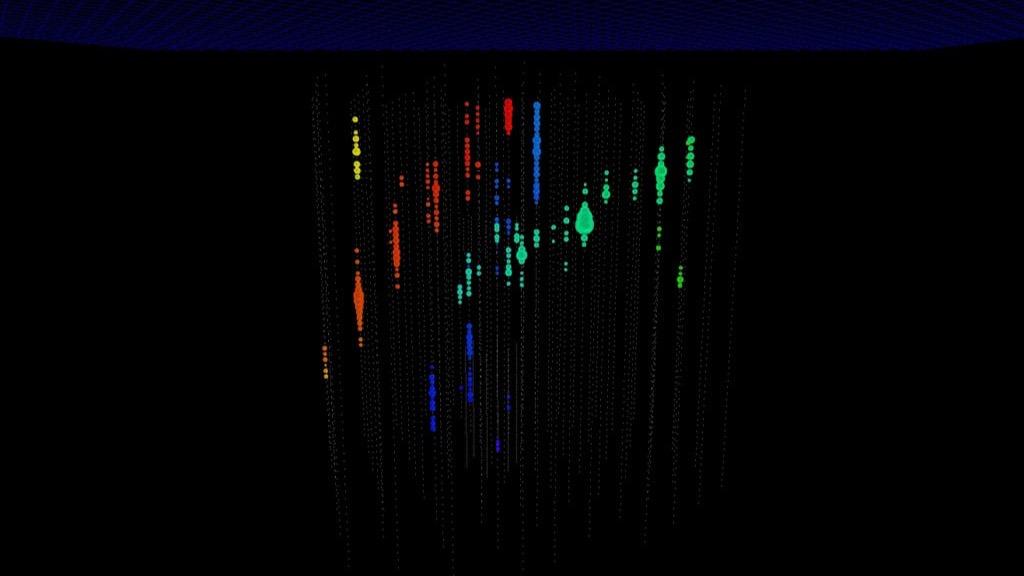
Two event shapes then stand out in the ice. A long straight track signals a muon, the heavy particle produced by a muon neutrino. Its direction is reconstructed with formidable precision, down to 0.3 degrees for a 100 TeV neutrino, a little more than half the apparent diameter of the Moon. A compact, ball-shaped blob, called a cascade, rather betrays an electron or tau neutrino, or another kind of interaction. Its energy is measured very well, to about 8%, but its direction stays fuzzy, around 5 degrees.
IceCube, a user's guide: 5,160 eyes under the ice
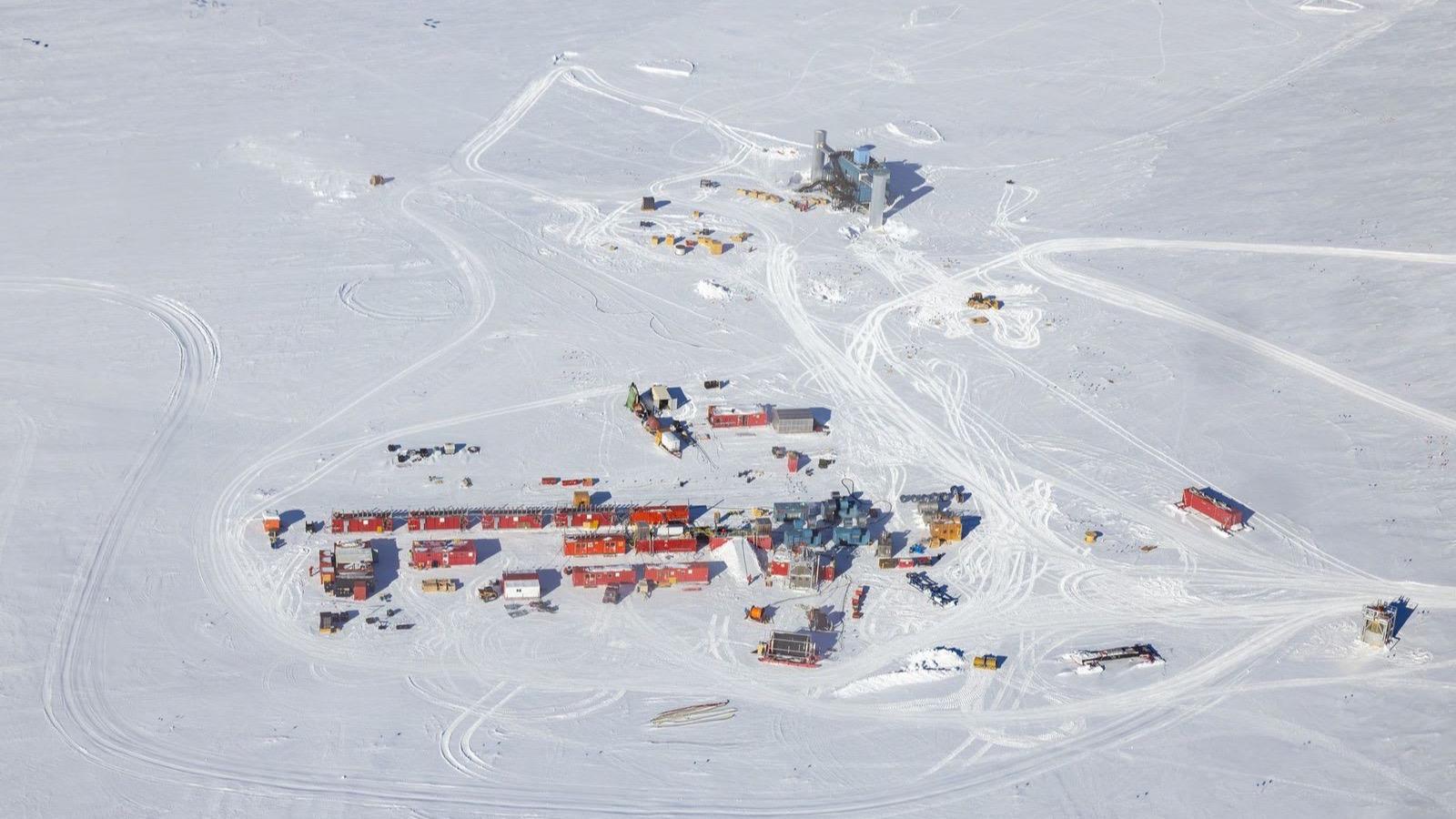
The detector fills a cubic kilometre of ice, between 1,450 and 2,450 metres below the surface, a few hundred metres from the Amundsen-Scott station, at the geographic South Pole. Its construction borrowed a technique from glaciologists: a high-pressure jet of hot water that melts the ice and drills a hole more than two kilometres deep. Into each hole the team lowers a string carrying 60 sensors, then lets the water refreeze. From 2005 to 2010, 86 strings were installed on a hexagonal grid, 125 metres apart, with 17 metres between sensors.
Each sensor is a digital optical module, a glass sphere the size of a football holding a photomultiplier tube 25 centimetres across, able to turn a tiny flash of light into an electrical signal. The Nobel Foundation offers a neat image for it: a light bulb working in reverse, catching light instead of producing it. In total, 5,160 of these spheres keep watch in the ice. The instrumented volume amounts to roughly a billion tonnes of ice.
Three secondary systems complete the picture. Depth first: a kilometre and a half of ice filters out most of the cosmic rays from the atmosphere, which would otherwise mimic a neutrino signal. IceTop next, an array of 81 surface stations, spots the showers of particles from the sky and flags them as background. DeepCore last, a cluster of eight strings packed tighter at the centre, 70 metres apart instead of 125, lowers the detection threshold to about 10 gigaelectronvolts, a million times less energy than the most energetic neutrinos.
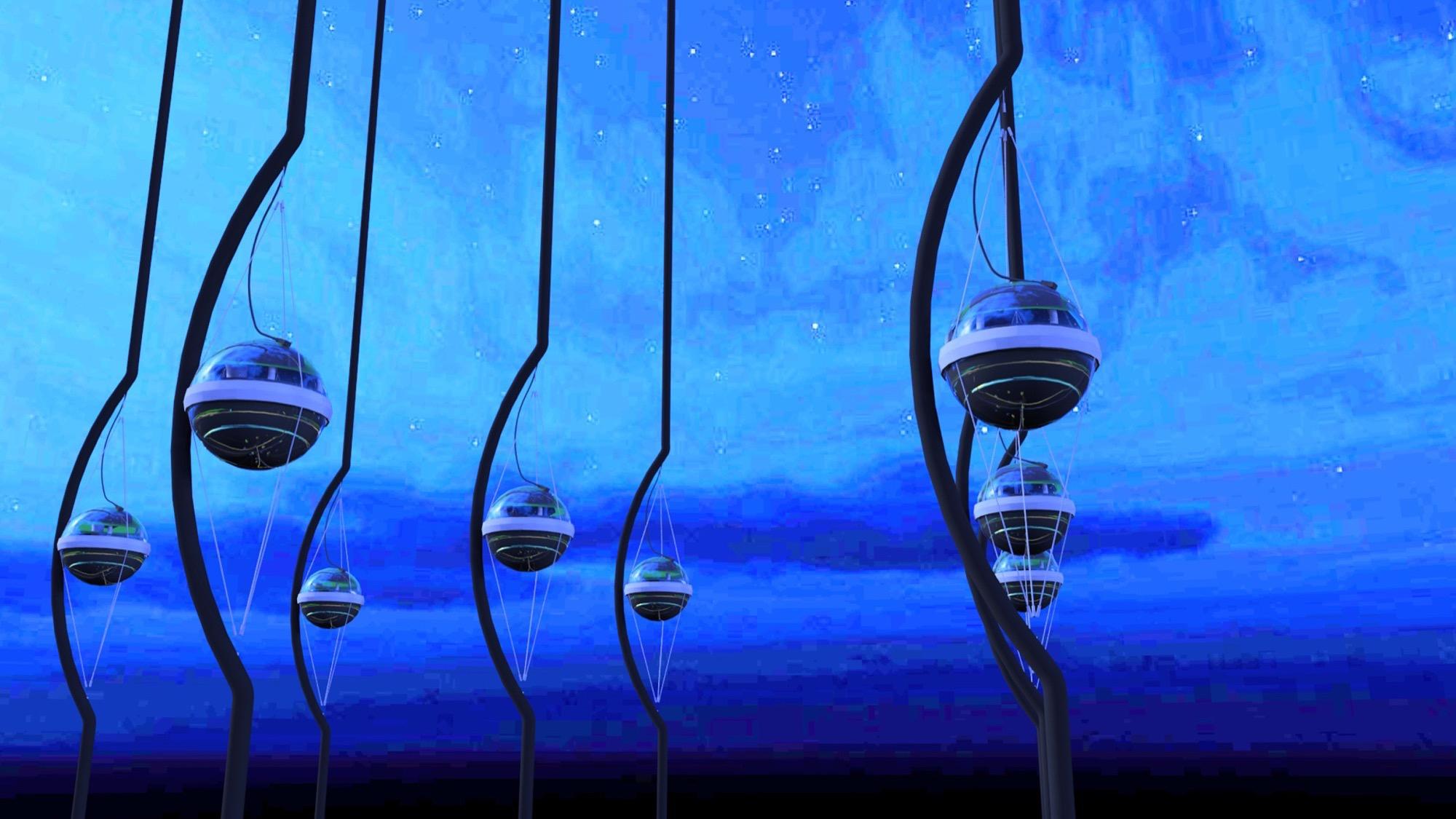
Once the signal is caught, everything plays out in the computers of the surface laboratory. The number of photons received gives the deposited energy. Their relative arrival times, compared between sensors, give the particle's direction. A muon neutrino can be detected even if it interacted far outside the instrumented volume, because the muon it produces travels about a kilometre through ice at a teraelectronvolt. The useful volume therefore far exceeds the geometric cube.
The final challenge is telling true cosmic neutrinos from the crowd of stray signals. Every day, more than a hundred million muons from the atmosphere cross the detector, and a few hundred atmospheric neutrinos join them after crossing the entire Earth from the northern hemisphere. Physicists discard the muons by keeping only tracks coming from below the horizon, which cuts the noise a thousandfold. And because the cosmic neutrino flux falls off more slowly with energy than the atmospheric one, the most energetic events are the ones that betray a distant origin. Of all the neutrinos recorded, about a hundred a year are expected to be astrophysical.
What the ice has already seen
The 2013 alert is the founding moment. While sifting two years of data for a completely different signal, the team stumbles on two events at about one petaelectronvolt, the most energetic ever seen. Two events are not proof, but they shape the strategy. Analysis of that same dataset turns up 28 high-energy neutrinos, between 30 TeV and 1.14 PeV, whose origin cannot be the atmosphere. In 2014 the collaboration put the rejection of the atmospheric explanation at 5.7 sigma, well past the 5-sigma discovery threshold. Neutrino astronomy was born.
In 2017, a neutrino of about 290 TeV lands in IceCube at the same time as a gamma-ray flare seen by the Fermi telescope, in the direction of the blazar TXS 0506+056, four billion light-years away. For the first time, a neutrino and a flash of light point to the same celestial object. It is the birth certificate of multi-messenger astronomy, which crosses several kinds of signal to tell one story.
In 2022, IceCube announced it had found, in its archives, 79 neutrinos of moderate energy coming from the active galaxy NGC 1068, also known as Messier 77, about 46 million light-years away. The concentration has a significance of 4.2 sigma. The core of that galaxy hides a supermassive black hole of 15 million solar masses, wrapped in a thick blanket of gas and dust. Visible light does not escape it, and the measured gamma rays are faint. Neutrinos, though, do. It is a perfect demonstration of the method: seeing inside what light cannot cross.
Then, in 2023, IceCube published the first image of our own galaxy in neutrinos, at a significance of 4.5 sigma. By applying machine learning to ten years of data, the collaboration found an emission along the plane of the Milky Way, where cosmic rays strike interstellar gas. An updated analysis, released in 2026 on twelve years of data, raised the detection to 5.7 sigma and made the Milky Way the first high-energy neutrino source crossed at the discovery threshold. That same year, IceCube announced its most energetic published neutrino, an 11.4 PeV event recorded in 2019.
What the Nobel changes, and what is still to come
This prize honours an instrument as much as a man. The lesson of IceCube lies in one simple idea: to open a new window on the universe, you sometimes have to build something bigger than anything you know how to build, in a place where nature has already supplied the material. Halzen did not stumble on a famous source by chance, he built the device that makes such discoveries possible, and he gathered enough people to fund it, drill it and run it for fifteen years.
The field does not stop here. IceCube was recently expanded, with the IceCube Upgrade, a set of denser, more sensitive strings that improves the detection of the lowest-energy neutrinos and allows a fresh look at the fifteen years of archived data. The next project, IceCube-Gen2, would aim for eight cubic kilometres of instrumented ice, eight times the current volume, to boost sensitivity to sources fivefold. Other detectors are rising around the world, in water this time: KM3NeT in the Mediterranean, Baikal-GVD in Siberia, TRIDENT in the South China Sea, P-ONE off Canada. In 2026, KM3NeT even reported a candidate neutrino of about 220 PeV, the most energetic ever signalled.
One reason to celebrate reaches beyond astronomy. This prize crowns a project that took decades of patience before delivering its first proof, carried by someone willing to stake his career on an intuition. In an interview with his university on the day of the announcement, Halzen put it plainly: "This is a celebration of a very unusual project." He added that success owed something to luck, and something to Wisconsin, where unconventional ideas can thrive. History will record that the most elusive particle in the universe finally let itself be seen, inside a block of ice, thanks to a man who refused to give up on it.
Going further
- The particle and the method: the neutrino and multi-messenger astronomy in our glossary.
- The giant black holes hiding in neutrino sources: the supermassive black hole, and the galaxy NGC 1068 seen by Hubble.
- Light from compact objects, another messenger: the Chandra telescope and its X-ray observations.
- Our article on a recent IceCube alert: a neutrino from space under the Antarctic ice.
- The particle cannot be seen through an amateur telescope, but the sky itself is waiting tonight: our interactive sky map and its observing guide.
- The official sources for this article: the 2026 Nobel Prize in Physics press release and its scientific background, the Nobel Foundation's popular information page, the official IceCube page on how the detector works, and the University of Wisconsin-Madison announcement.