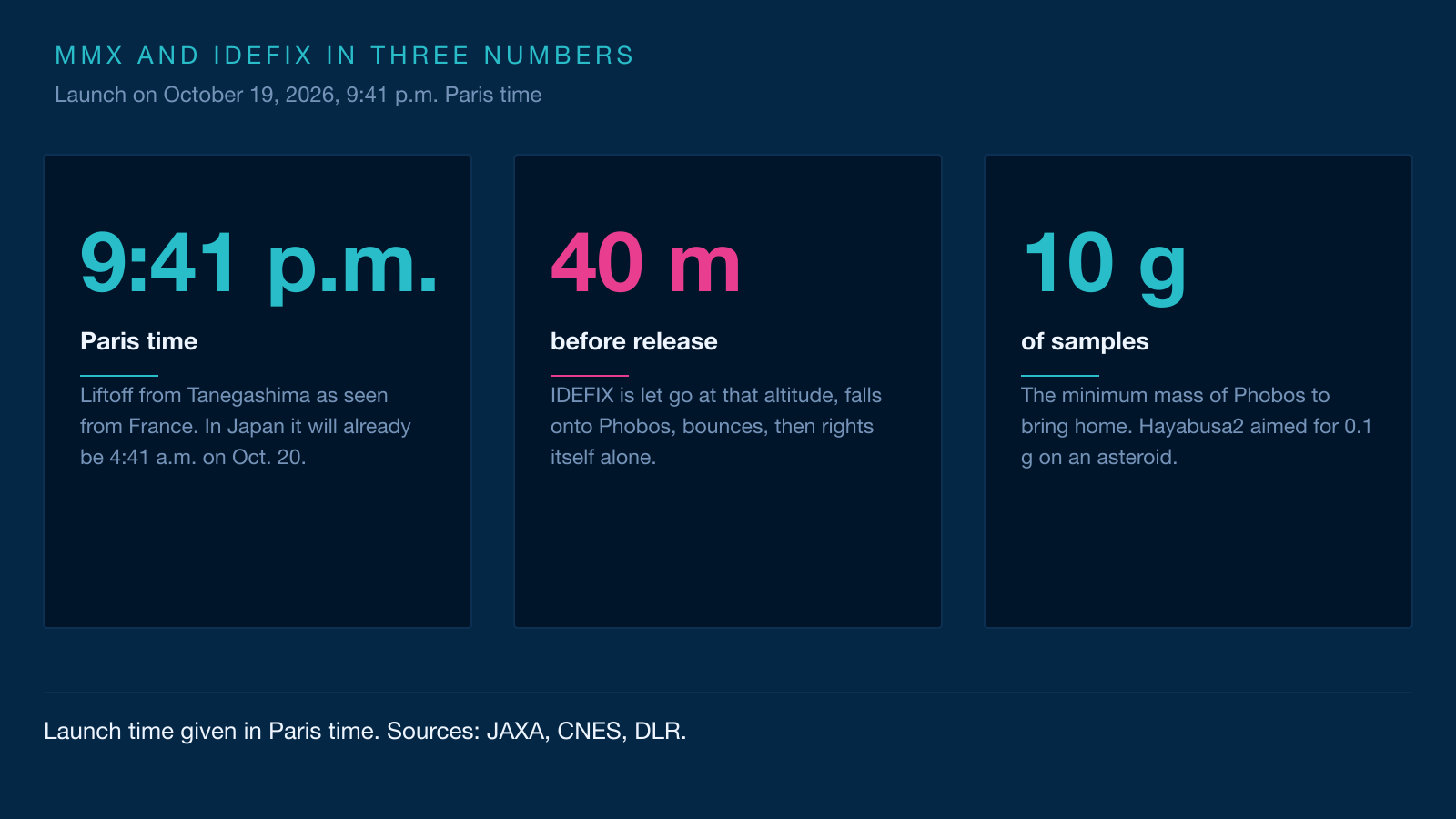
An H3 rocket is set to climb away from its pad at Tanegashima this Monday, Oct. 19, at 19:41 UTC, which is 9:41 p.m. in Paris. It carries MMX, the first probe tasked with bringing samples of a Martian moon back to Earth. Tucked inside is a 25 kg passenger designed in France and Germany: IDEFIX, a rover meant to touch down on Phobos before the mothership does.
A 9:41 p.m. liftoff, with a window open until Nov. 9
The schedule was locked the day before the flight. In an Oct. 18 release, the Japan Aerospace Exploration Agency set liftoff for Oct. 20 at 4:41:03 a.m. Japan time. In France it will still be Oct. 19, 9:41 p.m. So the countdown reads across two dates depending on where you watch from, a detail that explains plenty of muddled calendars.
The departure happens at the Yoshinobu launch complex, at the Tanegashima Space Center on an island in southern Japan. The rocket is an H3-24L, the most powerful version of Japan's launcher, with two LE-9 cryogenic engines and four solid rocket boosters. It stands 63 m tall and weighs 574 tonnes without its payload.
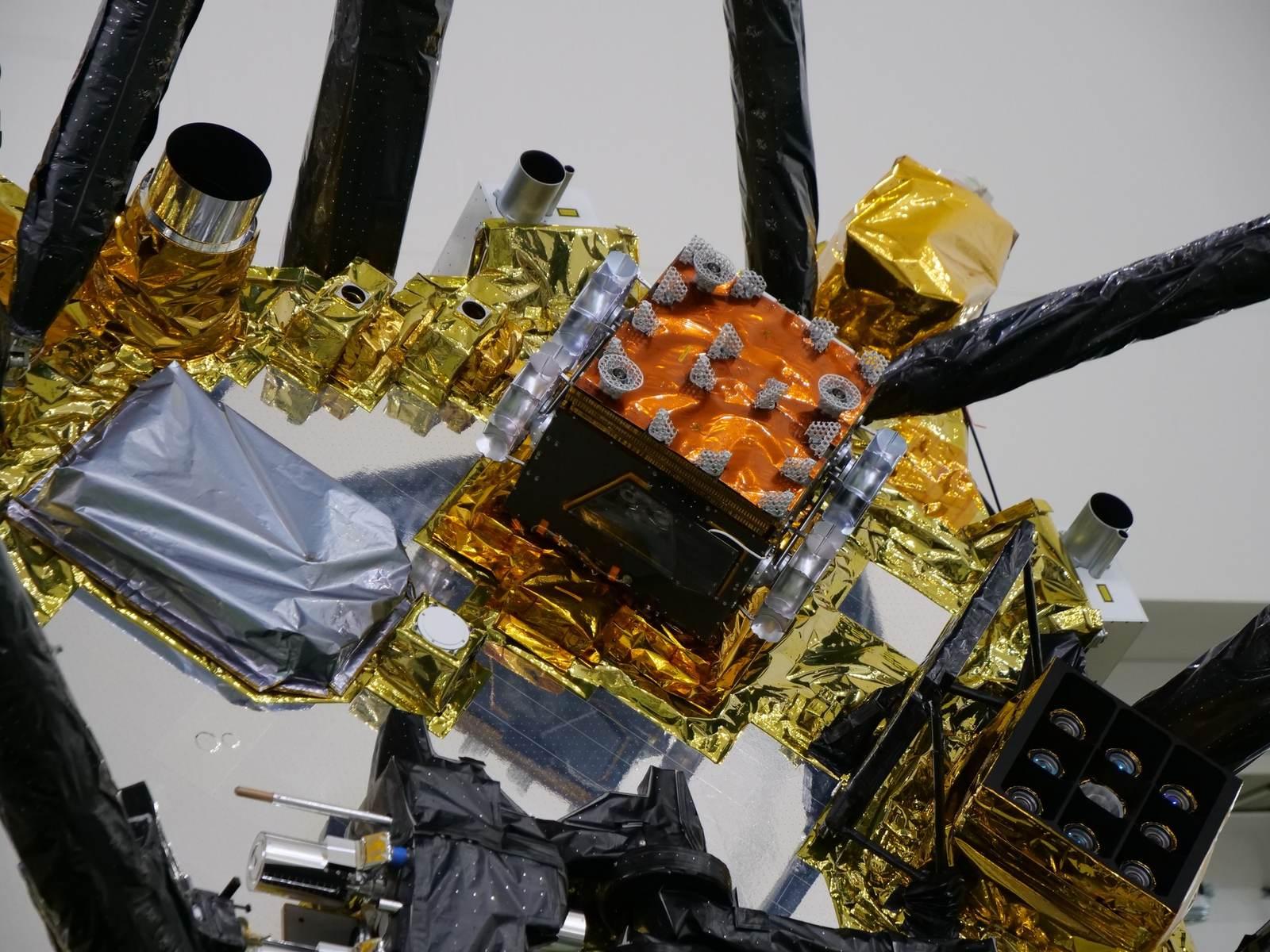
Inside, MMX tips the scales at 4,480 kg at liftoff, including 1,840 kg of propellant in the propulsion module and 1,190 kg in the return module. Three modules make up the stack: one pushes the probe to Mars, the second explores and lands, the third comes home with the sample capsule.
If the flight is scrubbed, the mission is not lost. JAXA has reserved a window from Oct. 21 to Nov. 9, 2026. Each new attempt gets its own exact time, because the position of Mars on its orbit dictates a narrow slot.
IDEFIX: 25 kg that has to land itself on a moon
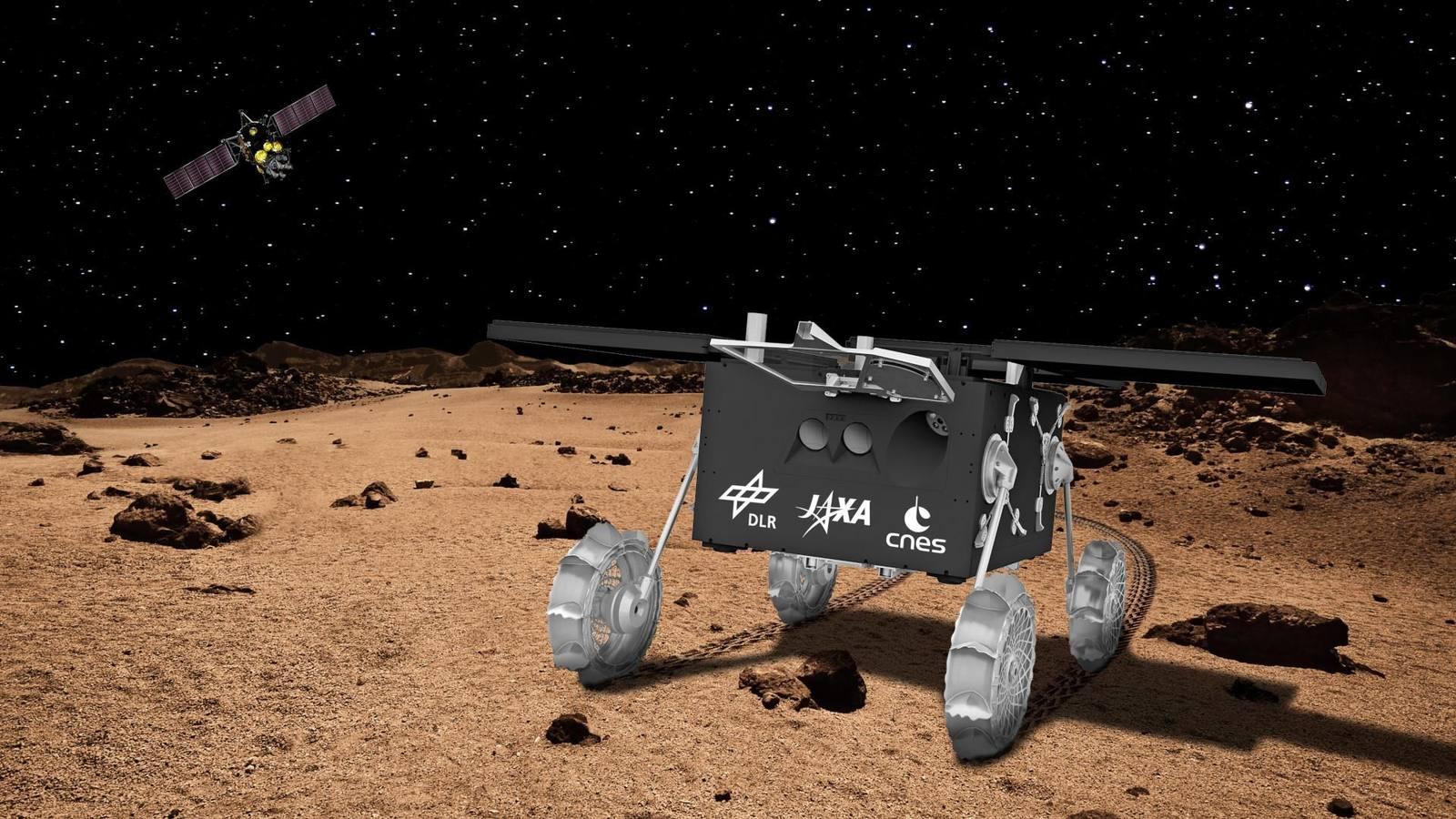
This is the strangest part of the mission, and it is the one that speaks French. IDEFIX measures 23 cm by 38 cm by 41 cm. It weighs 25 kg, of which 2.5 kg is science payload. It looks like a small box perched on four wheels mounted at the ends of articulated legs that can fold and unfold independently.
The release takes only seconds. During the spacecraft's first landing rehearsal, IDEFIX is let go about 40 m above the surface of Phobos. It falls in free fall. It probably bounces several times. Then, once at rest, it deploys its wheel assembly on its own and stands back up, with no command from Earth. It then opens its solar panels and recharges its batteries.
Autonomy here is a necessity, not a luxury. A signal round trip between Earth and Mars takes minutes, and nobody can catch a rover that has come to rest on its side. The uprighting sequence is therefore fully preprogrammed, with sensors checking that each step went as planned before moving to the next.
One number captures the scale of the problem: gravity. Phobos pulls about 1,800 times less hard than Earth. A 25 kg rover weighs the equivalent of just 15 grams there, about a handful of rice grains. Hence the idea of dropping it from height and letting it fall: braking such a slow descent would call for an engine heavier than the rover itself.
On the ground, IDEFIX creeps along at about 1 mm per second, or 3.6 m per hour. It is designed to work for at least 100 Earth days, generating at least 60 watt-hours per Phobos day, which lasts 7 hours. Four instruments ride along:
- RAX, a Raman spectrometer. A green 532-nanometre laser targets a 50-micrometre spot beneath the rover and reads the scattered light, which reveals the minerals present.
- miniRAD, a six-channel infrared radiometer that measures surface temperature and how the ground gives heat back.
- Two NavCams, a stereo pair used both for navigation and for imaging the terrain.
- Two WheelCams, aimed at the contact patch between wheels and soil, to study how strong the regolith is.
That last point matters more than it sounds. Regolith is the blanket of dust and debris covering any body without an atmosphere. Whether it is loose or packed, and how deep it goes, directly shapes the mothership's landing. IDEFIX is the scout.
Two competing stories for the origin of Phobos
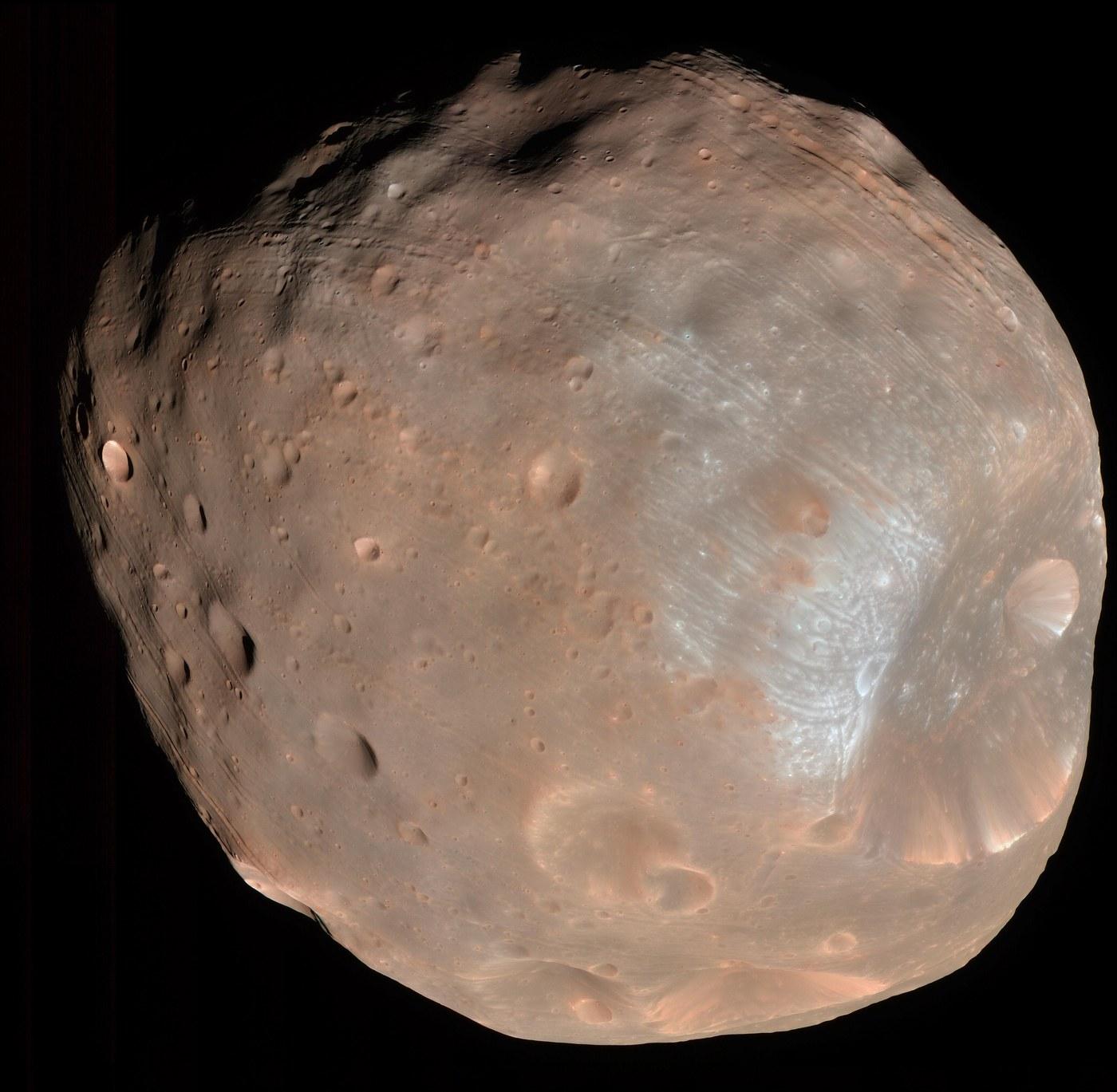
MMX is not going to Phobos by accident. Phobos is an irregular rock some 20 km across, circling Mars every 7 hours 39 minutes at an altitude of 7,800 km. No spacecraft has ever stayed there, and the few flybys never answered the simplest question: where did it come from?
Two ideas compete, and they tell two very different stories about Mars.
The first holds that Phobos and Deimos are captured asteroids. Their spectra resemble those of primitive D-type asteroids, dark bodies rich in carbon compounds, possibly carrying material from the outer solar system. That story would make the Martian moons witnesses to how material was distributed 4.6 billion years ago.
The second holds that a giant impact struck Mars and threw debris into orbit, which then clumped together into the two moons, much as the leading theory says Earth's Moon formed. The trouble with the first idea is right here: a captured asteroid would most likely keep an elongated, tilted orbit. Yet Phobos and Deimos travel on nearly circular paths, in line with the Martian equator.
Each scenario predicts a different chemical fingerprint. A captured asteroid would keep traces of its birthplace, notably volatile elements such as hydrogen. A moon born from an impact would instead carry a mix of Martian material and impactor material, cooked by the heat of the collision. The samples will decide.
Meanwhile, the probe measures. MIRS, an infrared imaging spectrometer, identifies surface minerals and looks for organic compounds. MEGANE, a gamma-ray and neutron spectrometer supplied by NASA, probes the chemical elements down to a few tens of centimetres. Its name means "glasses" in Japanese, and its lead scientist likes to say it looks at Phobos through gamma-ray glasses.
How to collect 10 g where gravity barely exists
Landing is the most delicate sequence of the mission. MMX will descend to Phobos twice, at two different sites, climbing back to orbit each time. The probe will sit on the surface for a few hours while it collects.
Two tools do the work. The first, C-SMP, is a corer: it drills and lifts a small column of material from at least 2 cm down. The second, P-SMP, is a pneumatic sampler supplied by NASA and built by Honeybee Robotics: it fires a burst of gas at the ground and captures the particles it kicks up. The goal is at least 10 g in total, against the 0.1 g Hayabusa2 targeted, which ended up bringing home 5.4 g.
Why dig instead of scooping at the surface? Because the top of Phobos has been sandblasted by the solar wind and micrometeorites for billions of years. That exposure alters the chemistry of the first few microns, a process called space weathering. Sampling below the altered layer means reading the original rock, not its packaging.
These samples also matter for Mars. Impacts blasted Martian rocks into space, and some fell back onto Phobos, which orbits close enough to collect far more of them than Deimos. Researchers hope to find fragments of the red planet, and with them indirect access to layers no rover will ever reach.
What France and Germany bring
IDEFIX is a binational machine, and the division of labour is clear-cut.
CNES, the French space agency, provides the navigation and exploration cameras plus the central service module, meaning the onboard computer, power and communications. It also provides MIRS, the infrared imaging spectrometer developed with the LIRA laboratory, and contributes to trajectory design alongside JAXA's space mechanics teams.
DLR, the German space agency, provides the chassis, the carbon-fibre landing gear, the entire uprighting and locomotion system, and the adapter that mates the rover to the mothership. It also supplies RAX and miniRAD, the two science instruments.
On the ground, the two countries operate the rover together from two centres: the Toulouse Space Centre for CNES, and the MUSC centre in Cologne for DLR. Part of the samples will go to France, with a curation facility to be built at the Muséum national d'histoire naturelle in Paris. NASA, for its part, is to receive at least 15% of the material, kept at Johnson Space Center in Houston.
One last detail: the name. IDEFIX is the dog in the Asterix comics by Goscinny and Uderzo. The choice echoes Astérix, France's first satellite, launched in 1965. The nod is official, made by CNES and DLR with the rights holders' agreement.
The road to 2031
The rest comes down to five dates.
August 2027, arrival in the Martian system. MMX drops its propulsion module and settles into a quasi-satellite orbit, a path that travels alongside Phobos on its rounds around Mars. Seen from Mars, the probe appears to follow the moon, while an observer standing on Phobos would see it tracing circles overhead.
September 2027 through 2028, mapping. The TENGOO and OROCHI cameras, the lidar and the MSA spectrometer chart the surface and its makeup, while the team picks landing sites.
Late 2028 or early 2029, IDEFIX is released, with first sample collection possible as early as December 2028 according to NASA. Two landings are planned, with a return to orbit in between.
2030, a last year around Phobos, then a higher orbit that repeatedly crosses Deimos's path for a series of flybys of the second moon. In late 2030, the exploration module separates and the return module fires its engine to escape Martian gravity.
2031, home. After eight months of travel, the capsule separates and re-enters the atmosphere for a parachute landing in the Woomera region of Australia.
Going further
- The MMX mission page, with its timeline, instruments and milestones.
- The concepts behind this story: Mars, the rover and the sample in our glossary.
- Our observing tools: the interactive sky map to find Mars and its neighbours, the observing guide and the astrophotography gallery.
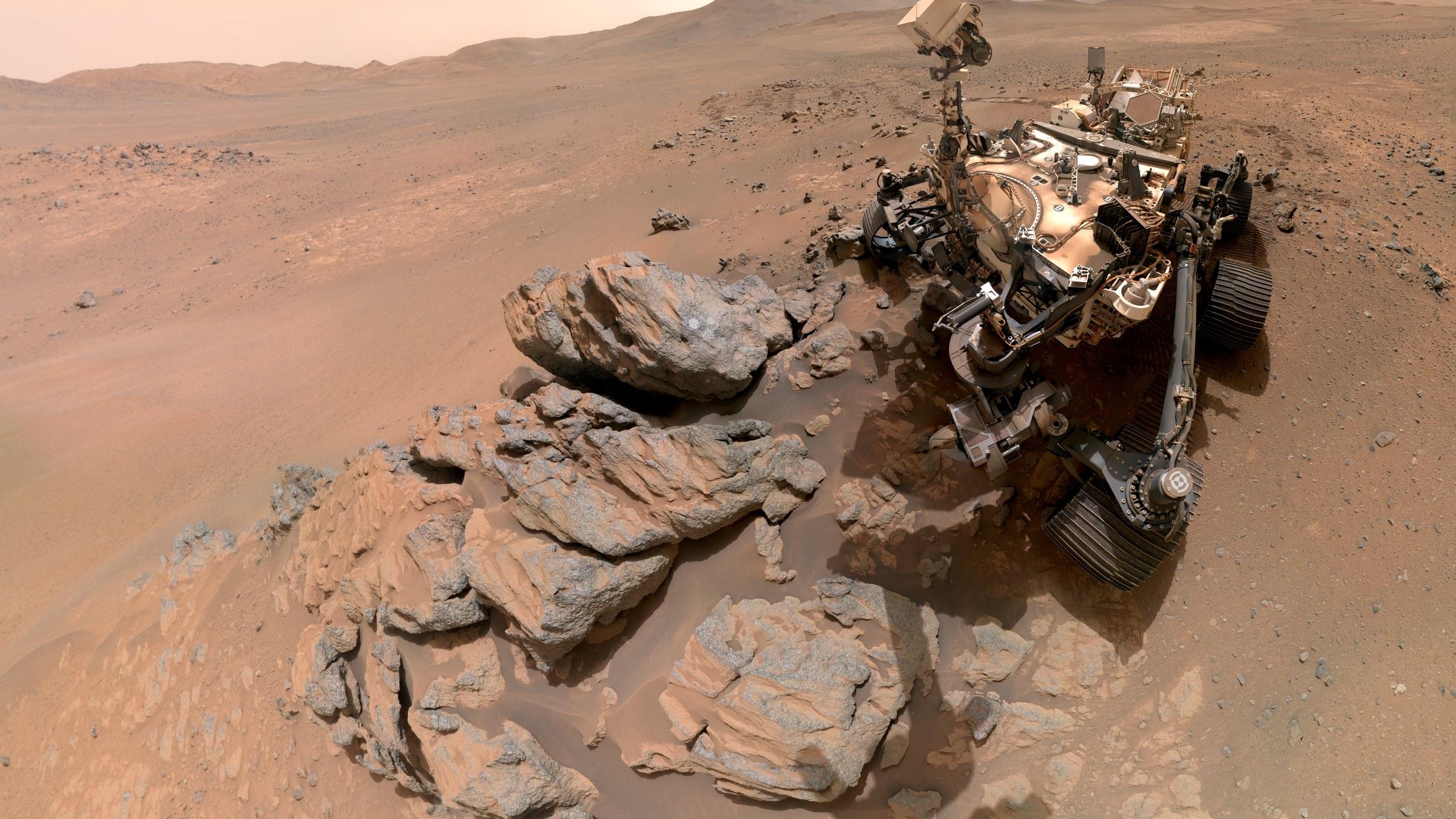
- The Martian side of exploration: our story on Earth filmed behind Phobos by Perseverance, which shows the same moon from the surface of Mars.
- The official sources for this article: the JAXA launch release, the CNES MMX page, the DLR IDEFIX fact sheet, the IDEFIX presentation, the ESA MMX page and the paper on IDEFIX operations in Progress in Earth and Planetary Science.